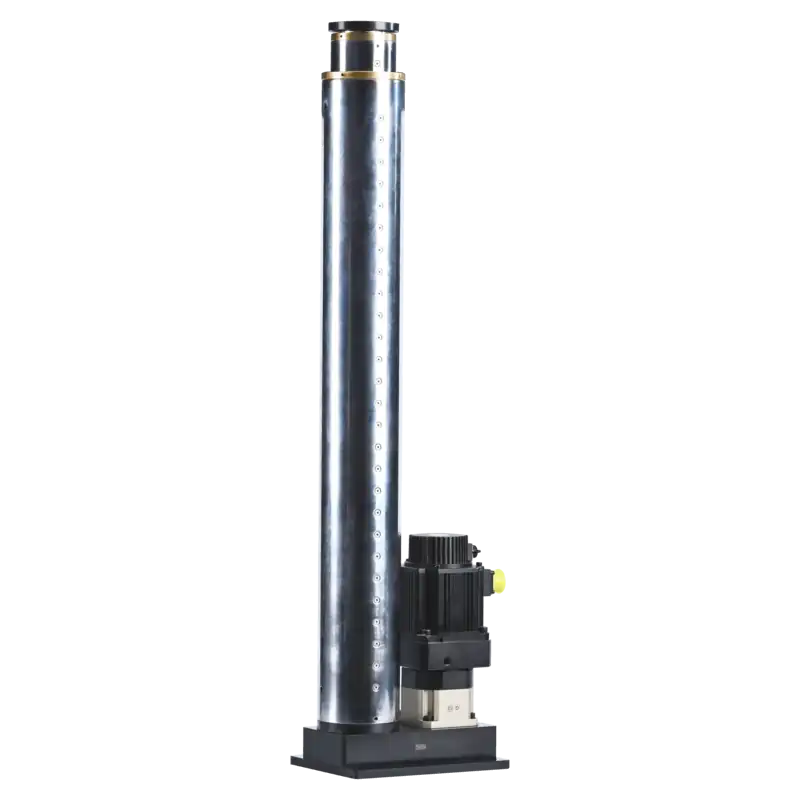
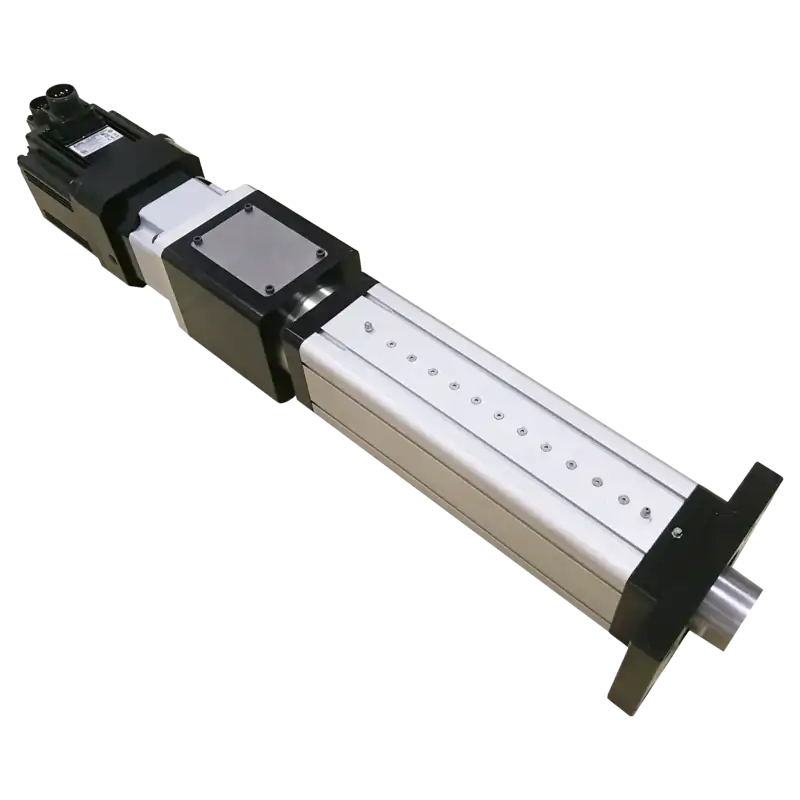
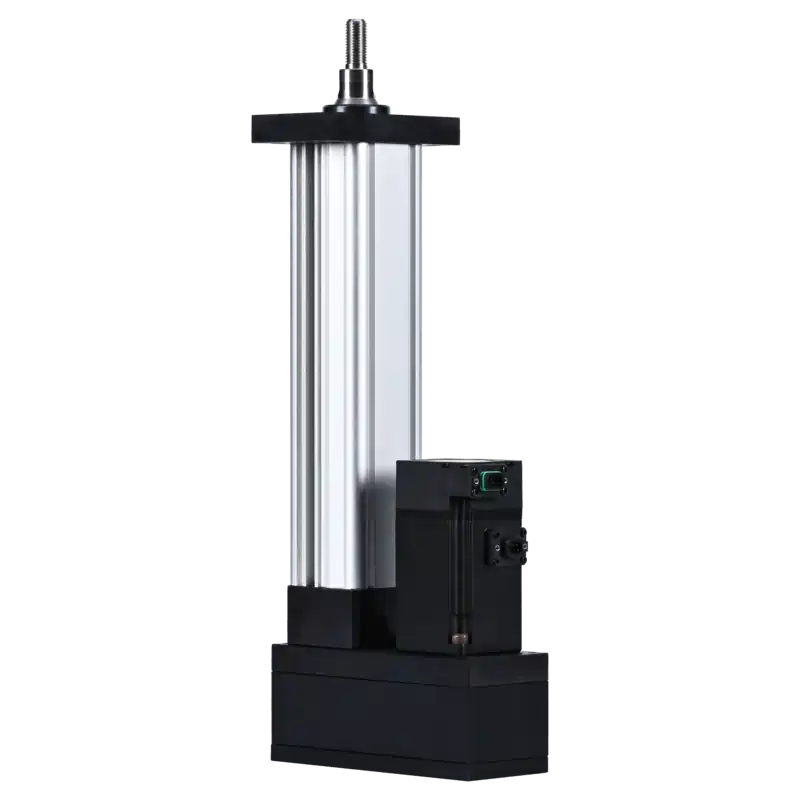
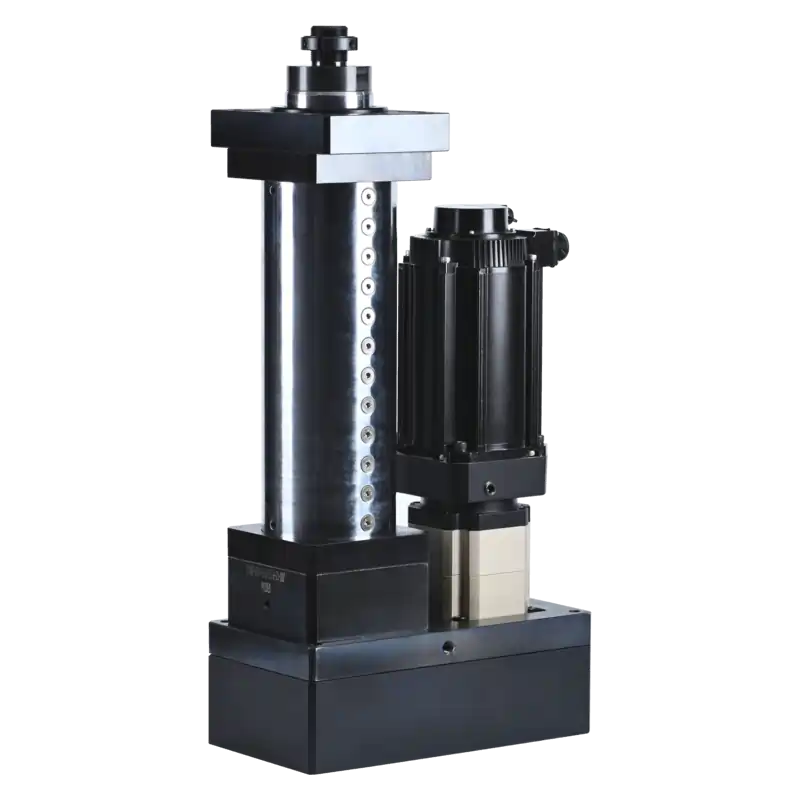
JRDJ Multi-Stage Telescopic Servo Electric Cylinder
Long travel from a compact footprint. Nested 3-stage or 4-stage screw-driven cylinders deploy up to 3750 mm of stroke from a 1450 mm retracted height — with servo closed-loop control for programmable position, speed, and force. Ideal for stage lifts, space-constrained automation, and long-stroke deployment where a single-stage cylinder simply won't fit.
For higher-force precision press fitting and positioning, see the JRDG Single-Stage Servo Electric Cylinder family (0.67–382 kN, 10 size models).
When Your Machine Is Too Short for the Stroke You Need
If any of these constraints sound familiar, a multi-stage telescopic servo electric cylinder may be the compact long-stroke solution you're looking for.
Installed Envelope Too Short
Single-stage cylinder won't fit; enclosure redesign required or stroke compromised
JRDJ answer: 3:1 to 10:1 stroke-to-retraction ratio. Deploy 3750 mm from a ~1600 mm retracted footprint. Nested stages extend sequentially when space is at a premium.
Stage & Platform Lifting
Hydraulic telescopic cylinders leak, are noisy, and lack programmable positioning
JRDJ answer: Clean electromechanical lifting with servo-controlled multi-position stops. No oil leakage, ≤60 dB(A) operation, and ±0.02 mm repeatability for precise stage alignment.
Space-Constrained Automation
Long-stroke single-stage actuator extends beyond machine boundaries
JRDJ answer: Compact retracted length fits inside tight machine frames. Telescopic extension only when needed — ideal for special installation stations and inline equipment.
Hydraulic Telescopic Replacement
Leakage, power-unit maintenance, heat, no process data, inflexible speed
JRDJ answer: All-electric telescopic actuation removes the hydraulic circuit. Programmable speed/position/force, energy on demand, and data-rich motion — verify force-speed-duty before conversion.
Multiple Position Stops Needed
Pneumatic/hydraulic telescopic cylinders only do end-to-end; mechanical stops required
JRDJ answer: Servo closed-loop control enables unlimited programmable positions with controlled acceleration/deceleration. Change recipes in software — no mechanical adjustment.
Moving Mass Is Critical
Heavy steel telescopic cylinders increase inertia and motor size
JRDJ answer: Aluminum barrel options (JRDJ-87, JRDJ-147) reduce moving mass for high-speed light-duty lifting. Steel barrels for medium-duty rigidity. Match barrel material to your load profile.
Multi-Stage Nested Screw Mechanism
The JRDJ uses nested screw-driven stages that extend sequentially — converting compact retraction into long deployed travel. The servo motor drives the primary stage; subsequent stages extend through mechanical nesting.
3-Stage vs 4-Stage: Choose by Envelope and Load
The number of nested stages determines the stroke-to-retraction ratio, maximum thrust, and mechanical rigidity. More stages = longer extension from the same retracted length, but with trade-offs in thrust capacity and column stability.
3-Stage (3:1 Ratio)
- Models: JRDJ-87, 88, 115, 163
- Stroke up to 2400 mm
- Higher thrust (up to 19 kN)
- Better rigidity and column stability
- Simpler synchronization
4-Stage (4:1 to 10:1)
- Models: JRDJ-145, 147
- Stroke up to 3750 mm
- Moderate thrust (up to 5.6 kN)
- Maximum extension ratio
- For extreme envelope constraints
Barrel Material Options
Is JRDJ the Right Fit?
Use this qualifier to determine whether a multi-stage telescopic cylinder is appropriate for your application, or whether a single-stage JRDG or alternative technology is better.
Good Fit Likely Match
Applications where compact long-stroke deployment is the primary driver:
- Stage lifting and platform elevation with limited ceiling height
- Space-constrained automation requiring long travel from short retraction
- Long-stroke deployment mechanisms (access hatches, covers, extensions)
- Hydraulic telescopic cylinder replacement for clean, programmable motion
- Multi-position lifting where pneumatic/hydraulic only does end-to-end
- Thrust requirements within 0.76–19 kN range
Engineering Review Required Verify First
Conditions requiring validation before selecting a telescopic configuration:
- Thrust requirements above 19 kN → consider JRDG single-stage
- Long compression strokes with significant side load (buckling risk)
- High-speed extension with heavy moving mass (inertia and control)
- Vertical lifting without fail-safe brake or mechanical lock
- Precision requirements below ±0.01 mm (specify accuracy/repeatability/resolution separately)
- IP66+ washdown or corrosive environment (standard is IP65)
- Continuous 24/7 duty with thermal buildup
- Personnel lifting or safety-critical applications (requires independent safety assessment)
Minimum Inputs for Engineering Qualification
Size Model Comparison
Six JRDJ models across 3-stage and 4-stage architectures. Filter by stage count, barrel material, or thrust level to find your candidate.
| Model | Stages | Barrel | Max Stroke | Retracted | Thrust (kN) | Speed (mm/s) | Motor (kW) | Configs |
|---|---|---|---|---|---|---|---|---|
| JRDJ-87 | 3-Stage | Aluminum | 2400 mm | 1450 mm | 0.76 | 333 | 0.4 | 1 |
| JRDJ-88 | 3-Stage | 20# Steel | 2400 mm | 1450/1480 mm | 2–3.8 | 100–200 | 0.4–0.75 | 4 |
| JRDJ-115 | 3-Stage | 20# Steel | 2400 mm | 1480 mm | 3.8–8.9 | 62.5–125 | 0.75–1 | 6 |
| JRDJ-145 | 4-Stage | 20# Steel | 3750 mm | 1625 mm | 2.1–5.6 | 75–150 | 0.75–1 | 4 |
| JRDJ-147 | 4-Stage | Aluminum | 3750 mm | 1625 mm | 0.9–5.6 | 75–300 | 0.4–0.75 | 4 |
| JRDJ-163 | 3-Stage | 20# Steel | 2300 mm | 1510 mm | 11.5–19 | 67–125 | 1.5–3 | 6 |
Thrust and speed ranges are configuration-dependent (gear ratio, screw lead, motor selection). They do not represent a single simultaneous operating point. Retracted heights vary by configuration — verify exact dimensions for your selected setup.
Direct vs. Parallel Drive
Both drive arrangements share the same telescopic cylinder body. The choice affects transmission efficiency, envelope, and motor placement — not the fundamental multi-stage mechanism.
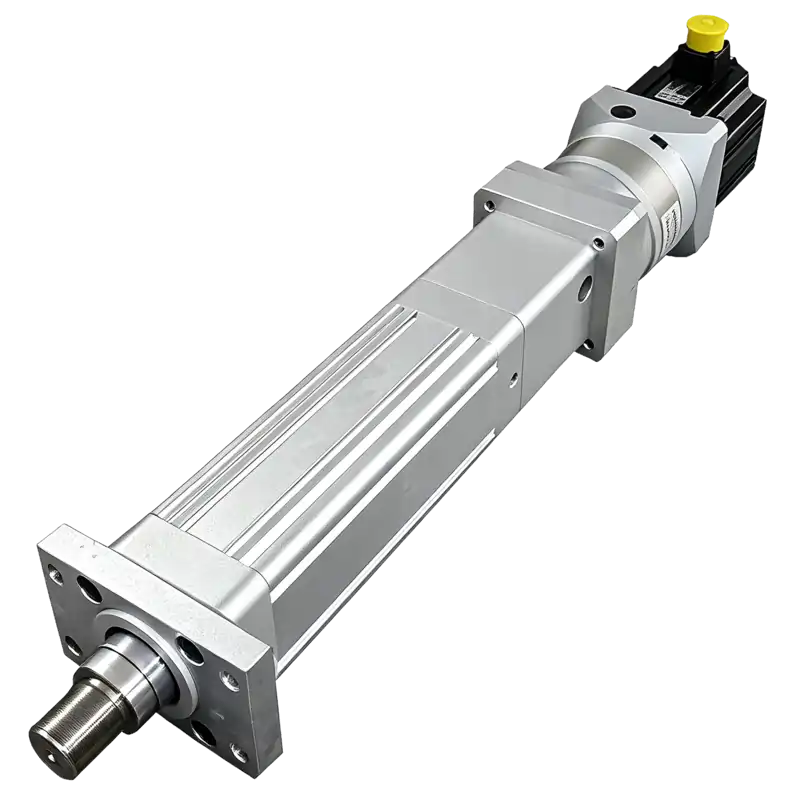
Direct (Inline) Drive
Motor in-line with cylinder axis
The servo motor couples directly to the primary screw shaft. Highest transmission efficiency (≥90%) and torsional rigidity, with a compact radial envelope. Overall length is longer due to the in-line motor extension.
- Efficiency≥90%
- Motor PositionIn-line with axis
- BacklashMinimal
- Radial EnvelopeCompact
- Overall LengthLonger
- Best ForPrecision, high rigidity
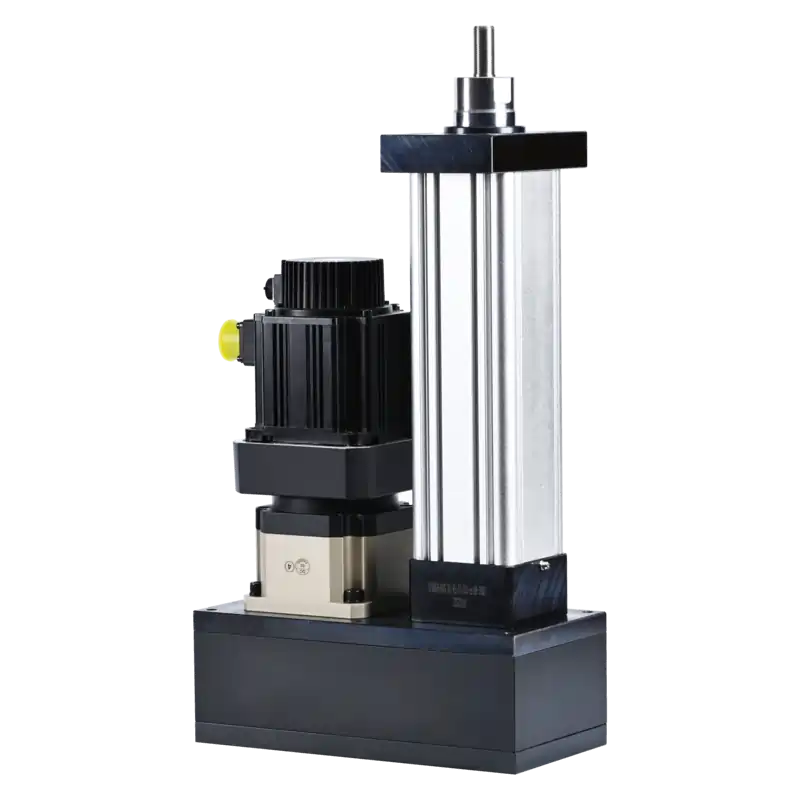
Parallel Drive
Motor side-mounted via belt/gear
The servo motor mounts parallel to the cylinder axis, connected via belt or gear transmission. Reduces overall length — critical for telescopic cylinders where retracted envelope is already constrained. Transmission efficiency ≥85%.
- Efficiency≥85%
- Motor PositionParallel to axis
- BacklashTransmission-dependent
- Radial EnvelopeWider
- Overall LengthShorter
- Best ForEnvelope-constrained mounting
From Family to Final Configuration
Follow this progressive sequence to narrow from the JRDJ family to a verified configuration. Stage count is the first and most structural decision.
Stage Count
3-stage or 4-stage
Size Model
Frame by stroke & thrust
Drive
Inline or Parallel
Barrel
Aluminum or Steel
Gear Ratio
Force-speed trade-off
Motor
Power & torque match
Mounting
Flange / foot / trunnion
Options
Brake, scale, sensor
Telescopic-Specific Checks: Long-stroke telescopic cylinders require column buckling analysis (especially 4-stage models at full extension), stage synchronization verification, and extended retracted-length dimensional confirmation. Do not assume manufacturability — submit to engineering for compatibility verification.
Configuration Performance by Model
Select a model to view its available gear-ratio configurations. Each configuration represents a different thrust-speed trade-off point.
| Config | Gear Ratio | Rated Thrust (kN) | Rated Speed (mm/s) |
|---|
Shared Family Specifications
Standard specifications across all JRDJ models. Model-specific dimensions and performance vary — refer to the size comparison and configuration tables above.
Precision & Control
| Positioning Repeatability | ±0.02 mm (std) |
| With Linear Scale | ±0.01 mm |
| Resolution | 0.1 μm |
| Thrust Accuracy | 0.5% (std) |
| Control Modes | Position / Velocity / Torque |
| Feedback | Encoder (std), Linear Scale (opt) |
Environment & Protection
| IP Rating | IP65 (std) |
| IP Optional | IP66 / IP67 |
| Operating Temp | -10°C to +80°C |
| Storage Temp | -20°C to +85°C |
| Humidity | 30–85% RH (non-cond.) |
| Noise Level | ≤60 dB(A) @ 1m |
Electrical & Communication
| Power Supply | AC 220V / 380V ±10% |
| Frequency | 50/60 Hz |
| Motor Type | AC Servo (domestic/import) |
| Fieldbus | EtherCAT / PROFINET |
| Other I/O | Modbus RTU / CANopen / P&D |
| Certification | ISO 9001:2015 |
Mounting & Dimensional Integration
Mounting options and mechanical interfaces for JRDJ telescopic cylinders. Extended/retracted dimension sheets available per configuration.
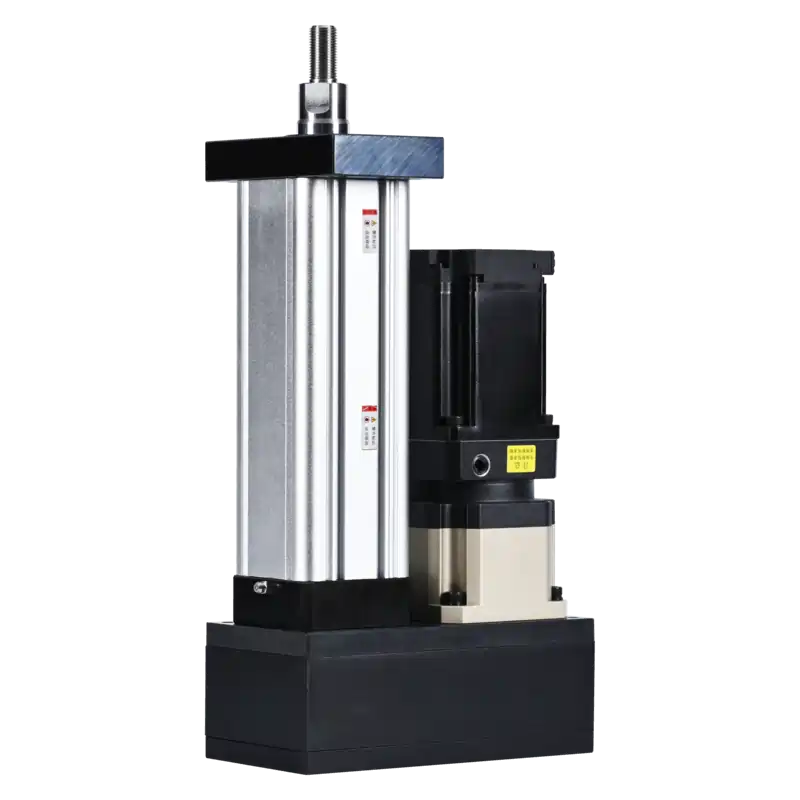
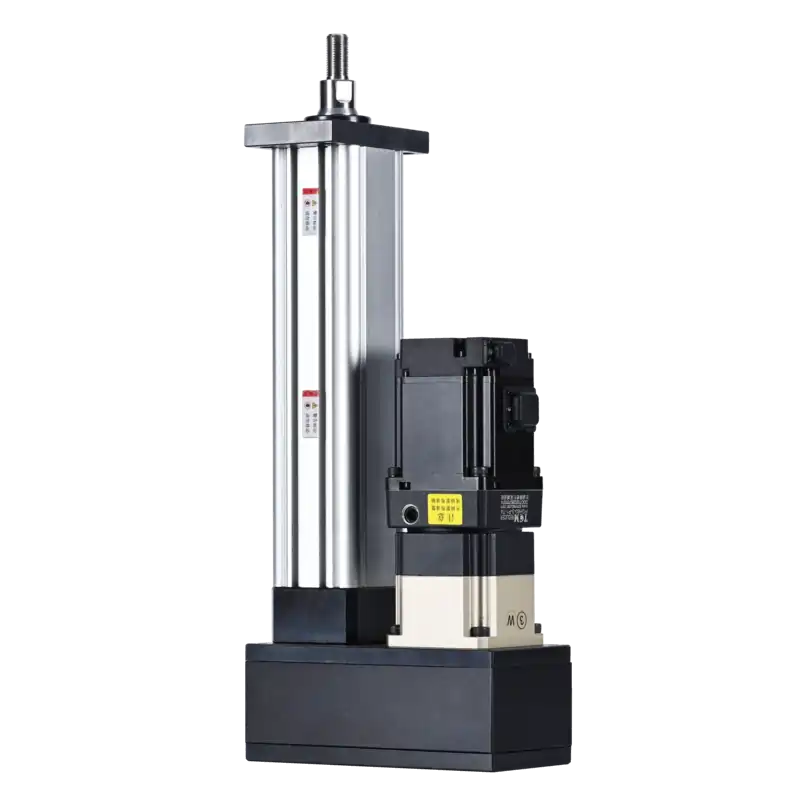
Mounting Configurations
Front Flange
Front-face flange mounting for fixed-frame installation. Common for vertical lifting platforms and stage mechanisms.
StandardRear Flange
Rear-face mounting when the cylinder body extends through the mounting surface. For compact axial envelopes.
StandardFoot / Trunnion
Side-foot or trunnion mounting for pivoting installations. Common in lifting platforms and articulated mechanisms.
OptionalRod-End & Anti-Rotation
Custom rod-end adaptations and anti-rotation features for telescopic stages. Critical for multi-stage alignment.
CustomServo Control, Feedback & Fieldbus
The JRDJ cylinder body is mechanically compatible with standard servo drive ecosystems. Communication protocols and control features are attributes of the selected drive/controller.
Servo Drive Compatibility
Accepts standard AC servo motor interfaces (domestic or imported). Drive selection determines current capacity, control modes, and tuning parameters.
Feedback Options
Motor-mounted encoder standard. Optional linear scale (grating ruler) for ±0.01 mm repeatability and 0.1 μm resolution. Optional load cell for force control.
Controller & Fieldbus
Compatible with PLC and motion controllers. EtherCAT, PROFINET, Modbus RTU, CANopen, and Pulse/Direction — determined by drive/controller selection.
Eight Critical Engineering Considerations
Telescopic cylinders have unique boundary conditions — especially column buckling at full extension and stage synchronization. Review each before final selection.
Column Buckling
Long multi-stage extension in compression is highly susceptible to buckling. Critical load drops significantly with each additional stage and extended length. Requires calculation per configuration.
Side Load
Telescopic stages are particularly sensitive to side load at full extension. Use external guides for any significant lateral force or moment. Rod should primarily carry axial load.
Stage Synchronization
Multi-stage extension requires proper stage sequencing and anti-rotation. Misalignment or binding causes premature wear. Verify synchronization mechanism for your application.
Vertical Safety
Vertical telescopic lifting requires fail-safe braking and potentially mechanical locks. A motor brake alone may not qualify as a safety device for personnel or load safety.
Continuous Duty / Thermal
Multi-stage friction plus motor/drive heat. High duty cycles require thermal verification. Telescopic efficiency losses (stage friction) add to thermal load vs single-stage.
Speed × Load
Maximum speed and maximum thrust are not simultaneously available. Gear ratio creates the trade-off. Verify your operating point falls within the configuration envelope.
System Accuracy
Multi-stage backlash and stage-to-stage compliance reduce effective precision vs single-stage. Specify accuracy, repeatability, and resolution separately with test conditions.
Environment
Telescopic stages have multiple sealing surfaces. IP65 standard; IP66/67 optional. Dust, moisture, and contaminants affect stage lubrication and wear more than single-stage.
Where JRDJ Telescopic Cylinders Excel
Application categories where multi-stage telescopic servo electric cylinders are well-suited or conditionally suited. These are fit descriptions, not case-study claims.
Stage & Platform Lifting
Theater stages, exhibition platforms, and adjustable work platforms requiring compact retracted height with long deployed travel. Programmable multi-position stops and smooth acceleration/deceleration.
Space-Constrained Automation
Special installation stations and inline equipment where ceiling or floor space limits single-stage cylinder length. Telescopic extension deploys only when needed.
Long-Stroke Deployment
Access hatches, covers, extension mechanisms, and deployable structures requiring large extension ratio from minimal storage envelope.
Hydraulic Telescopic Replacement
Clean replacement for hydraulic telescopic cylinders in lifting and deployment applications. Eliminates oil leakage, power-unit maintenance, and heat — adds programmable motion and data.
Lifting & Material Handling
Vertical lifting and hoisting with verified load. Requires fail-safe braking, buckling analysis, and duty-cycle verification. Not for personnel lifting without independent safety certification.
Precision Press Fit
Light press fitting within thrust range (≤19 kN). For higher-force precision pressing, the JRDG single-stage family offers better rigidity and force-speed envelope. Verify column stability at pressing point.
JRDJ Telescopic Cylinder FAQ
Direct answers for telescopic cylinder selection, comparison, and quotation scope. Structured for AI search and engineering reference.
What is a multi-stage telescopic servo electric cylinder?
A multi-stage telescopic servo electric cylinder uses nested screw-driven stages that extend sequentially, delivering long travel from a compact retracted footprint. The JRDJ offers 3-stage (3:1 ratio) and 4-stage (4:1 to 10:1 ratio) configurations, with servo closed-loop control for programmable position, speed, and force.
What is the stroke-to-retraction ratio of JRDJ cylinders?
3-stage models (JRDJ-87, 88, 115, 163) deliver approximately 3:1 stroke-to-retracted-length ratio. 4-stage models (JRDJ-145, 147) achieve 4:1 or higher, up to 10:1 depending on configuration. For example, JRDJ-145 extends 3750 mm from a 1625 mm retracted height.
When should I choose 3-stage vs 4-stage?
Choose 3-stage for higher thrust and rigidity with moderate stroke needs (up to 2400 mm, up to 19 kN). Choose 4-stage when maximum stroke is critical and the envelope is extremely constrained (up to 3750 mm from ~1625 mm retracted). 4-stage trades some thrust and rigidity for longer extension ratio.
Aluminum vs steel barrel — which should I choose?
Aluminum barrels (JRDJ-87, JRDJ-147) are lightweight and best for light-duty, high-speed lifting where moving mass matters. 20# steel barrels (JRDJ-88, 115, 145, 163) offer higher rigidity and load capacity for medium-duty lifting and continuous operation.
Can a JRDJ telescopic cylinder replace a hydraulic telescopic cylinder?
Yes, when clean operation, programmable motion, or process data is needed. Compare the complete force-speed-duty envelope: JRDJ covers 0.76–19 kN. For thrust above 19 kN or severe shock duty, a single-stage JRDG or hydraulic solution may be more appropriate.
What is the maximum stroke of JRDJ multi-stage electric cylinder?
The maximum observed stroke is 3750 mm (JRDJ-145 and JRDJ-147, 4-stage models). 3-stage models offer up to 2400 mm. Retracted heights range from 1450 mm to 1625 mm depending on model.
What positioning accuracy does the JRDJ achieve?
Standard repeatability is ±0.02 mm. With an optional linear scale (grating ruler), repeatability improves to ±0.01 mm with resolution down to 0.1 μm. Note that multi-stage compliance may reduce effective system accuracy vs single-stage — specify accuracy, repeatability, and resolution independently.
I need more than 19 kN thrust — is JRDJ still right?
For thrust requirements above 19 kN, we recommend the JRDG single-stage servo electric cylinder family, which covers 0.67–382 kN across 10 size models. JRDJ is optimized for compact long-stroke deployment, not maximum thrust. Our engineering team can help determine which family fits your application.
Technical Resources & Evidence
Documentation and manufacturing evidence for the JRDJ telescopic cylinder family. Request per-model or per-configuration resources as needed.
Product Datasheet
Per-model specification sheets with configuration tables
Request per ModelDimension Drawings
Extended/retracted 2D drawings and 3D CAD models
Request per ConfigSelection Guide
Telescopic cylinder sizing and buckling calculation worksheets
Available on RequestManufacturing Evidence
Factory, assembly, inspection, and testing documentation
Evidence Pack in PrepTest Reports
Load testing, extension/retraction verification records
Available on RequestCompliance Docs
ISO certification and material certificates
ISO 9001:2015Ready to Spec Your JRDJ?
Get an engineering-verified telescopic cylinder configuration. Our team will match stage count, drive arrangement, barrel material, and motor to your stroke and envelope constraints.