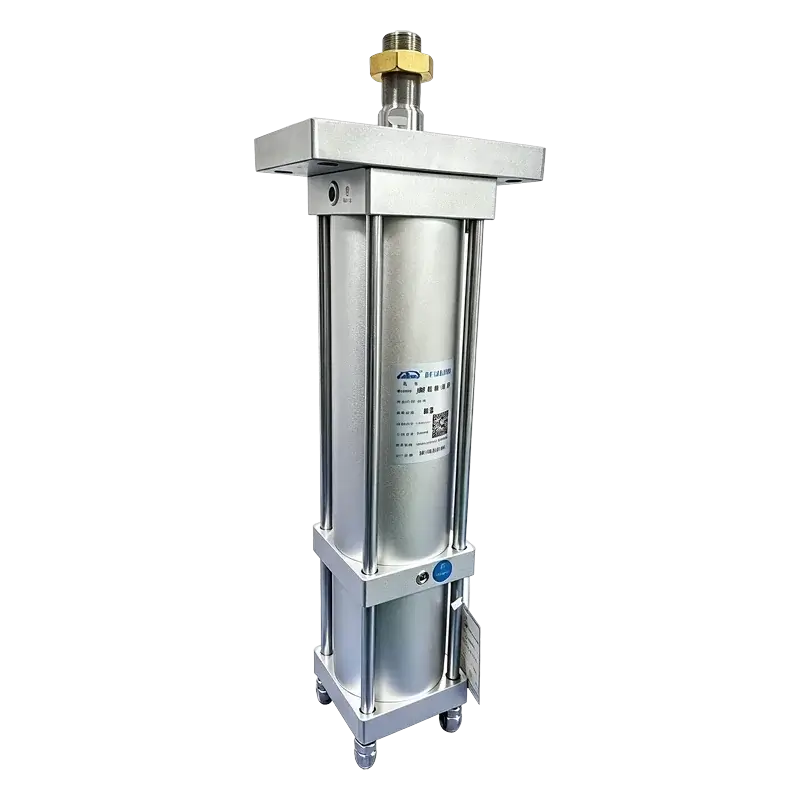
JRNT composite mini inverted cylinder — upward-force configuration
JRNT Mini Inverted Hydro-Pneumatic Booster Cylinder
The most compact upward-pressing cylinder in the JiuRong line. JRNT combines the composite mini body architecture with inverted mounting — for machines that need upward force in a space too small for a standard inverted cylinder.
JRNT is a derivative/non-standard series. Specifications reference JRG (mini) and JRT (inverted) parent lines and are confirmed per order with our engineering team.
Why Choose the Mini Inverted?
Most cylinders solve one problem: size or direction. JRNT solves both at once. It sits at the intersection of two proven architectures — the compact composite mini body and the upward-pressing inverted mount.
JRG — Mini Body
Compact composite body with integrated reservoir. Small footprint, fast cycles. But the rod presses downward only.
Smallest bodyJRT — Inverted Mount
Rod extends upward for pressing from below. But the parallel-layout body is larger and may not fit compact machines.
Upward forceJRNT — Mini Inverted
The intersection: smallest body + upward force. For machines where JRT is too big and JRG presses the wrong way.
Both at onceUltra-Compact Footprint
Composite mini body fits where standard inverted cylinders cannot. Ideal for compact automated work cells with limited mounting area and vertical clearance.
Upward Force Output
Inverted mounting with rod-end upward force. Presses from below — perfect for upward press-fitting, bottom-up forming, and inverted workholding.
Fast Cycle, Stable Force
Two-stage pneumatic-hydraulic design delivers fast approach (up to 400 mm/s) and stable high-force output. Reference frequency 30–60 cycles per minute.
Built for Non-Standard Automation
Designed for the growing class of compact automation — electronics assembly, lithium battery, packaging, medical — where every millimetre counts.
How the JRNT Works
JRNT uses the proven two-stage hydro-pneumatic principle shared with JRG and JRT: a fast low-force pneumatic approach followed by a short high-force hydraulic power stroke — with the rod travelling upward. Four ports (A/B/C/D) and two solenoid valves (DT1/DT2) control the complete cycle.
Force vs. Displacement Profile
The rod extends upward on compressed air for the long approach stage. On workpiece contact, the hydraulic booster engages for the final 5–20 mm at full tonnage — pushing upward.
Four-Step Upward Cycle
-
01
Pneumatic Approach (Up)
Solenoid valve DT1 energizes. Shop air drives the piston upward at high speed (up to 400 mm/s) with low force — covering the approach stroke with minimal air consumption.
-
02
Workpiece Contact
The upward-moving ram contacts the workpiece from below. Pneumatic force alone is insufficient for the operation — this triggers the hydraulic boost phase.
-
03
Hydraulic Power Stroke (Up)
Solenoid valve DT2 energizes. The booster piston pressurizes the hydraulic oil, multiplying force to rated tonnage for the final 5–20 mm of upward travel.
-
04
Pressure Release & Return (Down)
DT2 de-energizes to release hydraulic pressure, then DT1 de-energizes. The double-acting pneumatic return retracts the rod downward to home position — ready for the next cycle.
Pneumatic Circuit (4-Port A/B/C/D)
Circuit schematic shown for principle reference. JRNT-specific port positions and dimensions are confirmed with engineering per order.
Technical Specifications
Reference values derived from the JRG (mini composite) and JRT (inverted) parent series. JRNT is a derivative product — final bore, stroke, force, and dimensional specifications are confirmed per order with our engineering team.
Performance
- Output force range
- 1–14T (reference, JRG parent)
- Operating pressure
- 4–7 kgf/cm² (shop air)
- Pre-press stroke
- Custom per application
- Power (boost) stroke
- 5–20 mm typical
- Cycle frequency
- 30–60 cycles/min (reference)
- Actuation speed
- 50–400 mm/s
Construction
- Body type
- Composite mini with integrated reservoir
- Mounting
- Inverted (rod extends upward)
- Action
- Double-acting, two-stage (DT1+DT2)
- Hydraulic fluid
- VG68 anti-wear hydraulic oil
- Operating temp.
- 0–60°C
- Bore options
- Per engineering confirmation
Control & Interface
- Pneumatic ports
- 4 ports (A/B/C/D)
- Solenoid valves
- Two 5/2-way (DT1, DT2)
- Control signal
- 24V DC (standard) / per request
- Return force
- Confirmed per order
- Mounting style
- Flange / foot / custom
- Customization
- Non-standard configurations available
JRNT vs. JRT vs. JRG
The decision comes down to two questions: How much space do you have? and Which direction must the force go?
JRG
Mini Composite- Body sizeSmallest (mini composite)
- Force directionDownward only
- Catalog dataStandard — dimensions & force tables published
- Force range1–14T
- Lead timeStandard production
Choose JRG when: you need the smallest body and the rod presses downward.
JRT
Inverted Long-Stroke- Body sizeLarger (parallel-layout body)
- Force directionUpward (inverted)
- Catalog dataStandard — dimensions & force tables published
- Force range1–40T
- Lead timeStandard production
Choose JRT when: you need upward force and the parallel-layout body fits your machine.
JRNT
Mini Inverted- Body sizeSmallest (mini composite)
- Force directionUpward (inverted)
- Catalog dataDerivative — confirmed per order
- Force rangeLikely ≤14T (engineering confirm)
- Lead timeNon-standard — consult factory
Choose JRNT when: you need upward force AND the machine is too compact for JRT.
How to Select Your JRNT
Because JRNT is a derivative series, selection is a collaborative process. Provide these seven parameters and our engineering team will confirm the exact configuration.
Bore Diameter
Required oil cylinder bore or total bore (mm). Determines the force envelope and body dimensions.
Pre-Press Stroke
The fast-approach distance before workpiece contact (mm). Longer strokes need verification for inverted stability.
Power Stroke
The high-force boost distance (mm), typically 5–20 mm. Determines total stroke and oil displacement.
Output Tonnage
Required pressing force in tons. JRNT likely covers the lower range (≤14T) due to mini architecture.
Cycle Frequency
Required cycles per minute. Reference range 30–60 cpm; actual depends on stroke length and load.
Return / Lifting Force
Inverted cylinders must retract against gravity. Specify the required return force in kgf.
Mounting Space & Fixing Method
Available envelope, upward force direction, and flange/foot mounting preference. This is the critical constraint for JRNT.
Build Your JRNT Model Number
Select your parameters below to generate a reference model code. This is a planning reference — our engineering team will confirm the final specification before order acceptance.
Reference code only. Final bore, stroke, force, and mounting dimensions confirmed by JiuRong engineering before order.
Where the JRNT Fits
JRNT serves compact automation where upward force is needed in a small envelope — electronics, battery, packaging, medical, and other non-standard equipment.
Upward Press-Fitting
Bearings, pins, and bushings pressed from below into housings. The inverted ram reaches up through fixture plates in compact cells.
Electronic Component Riveting
Small rivets and terminals in electronics assembly. Mini body fits benchtop and inline automation with limited vertical space.
Plastic Welding
Ultrasonic and heat-staking plastic assembly. Stable upward force with fast cycle rates supports high-volume production.
Metal Sheet Forming
Light forming, bending, and embossing of thin sheet metal from below. Compact footprint for progressive die and fixture integration.
Marking & Stamping
Embossing, coining, and part marking from below. Short power stroke delivers consistent impression force in a small package.
Precision Assembly
Clip insertion, snap-fit assembly, and delicate press operations. Controlled two-stage force avoids part damage.
Engineering Note: Derivative Product
JRNT is not a standard catalog series. It is a derivative combining two proven architectures. Here is what that means for your project.
What We Confirm Per Order
- Exact bore and body dimensions
- Total stroke and power stroke combination
- Rated output force and return force
- Mounting flange / foot pattern
- Port positions and pneumatic interface
What to Provide
- Available mounting envelope (W × D × H)
- Required tonnage and stroke
- Cycle rate and duty cycle
- Workpiece weight (for return force)
- Mounting orientation and fixing method
When to Choose Standard Instead
- If JRT fits your space — it is a standard catalog product
- If you press downward — JRG mini is simpler and standard
- If you need published dimension/force tables immediately
- If force exceeds ~14T — consider JRT (up to 40T)
Frequently Asked Questions
What is the smallest inverted booster cylinder JiuRong offers?
The JRNT is the most compact upward-pressing cylinder in the JiuRong line. It combines the composite mini body (shared with the JRG series) with inverted mounting (shared with the JRT series), giving you the smallest possible body with upward force output.
How does JRNT differ from JRT?
Both press upward, but the JRT uses a larger parallel-layout body while the JRNT uses the compact composite mini body. If the JRT fits your machine, choose JRT — it is a standard catalog product with published dimensions and force tables. Choose JRNT when the mounting area is too small for JRT.
How does JRNT differ from JRG?
Both use the compact composite mini body, but the JRG rod presses downward while the JRNT rod extends upward (inverted). If your operation presses from above, JRG is the standard choice. If you need to press from below in a compact space, JRNT is the answer.
Is JRNT a standard catalog product?
JRNT is a derivative/non-standard series. It is available and buildable, but it does not have an independent catalog with published dimension drawings and force tables. Each order is confirmed with our engineering team based on your application requirements. Lead time and pricing may differ from standard series.
What force range does JRNT cover?
JRNT does not have independently catalogued force data. Based on the JRG mini parent architecture, the expected range is approximately 1–14 tons. The exact force depends on bore, shop air pressure, and boost ratio — all confirmed by engineering for your specific configuration.
What is the cycle rate?
Reference frequency is 30–60 cycles per minute, based on the JRG mini composite architecture. Actual cycle rate depends on stroke length, load, and air supply volume. Our engineering team will verify this for your specific stroke and duty cycle.
Can I get a dimension drawing before ordering?
Yes. After you provide your bore, stroke, tonnage, and mounting requirements, our engineering team will issue a confirmation drawing for your approval before production. Because JRNT is a derivative series, dimensions are configuration-specific rather than catalog-standard.
What information do I need to request a quote?
Provide the seven selection parameters: bore, pre-press stroke, power stroke, tonnage, cycle frequency, return/lifting force, and mounting space. Photos or drawings of your machine layout are also helpful. Use the “Request a Quote” button and our team will respond within one business day.
Documentation & Support
Need Upward Force in a Compact Space?
Tell us your mounting envelope and force requirements. Our engineering team will confirm the JRNT configuration — or recommend the best standard alternative.