How to Choose a Cost-Effective Actuator for a Riveting Press
Selecting an actuator for a riveting press starts with the work the press must perform—not with a cylinder tonnage label or the lowest quoted price. A hydro-pneumatic booster cylinder can be a sensible choice when substantial force is required mainly over a short working stroke, provided that air supply, duty cycle, tooling, and control requirements fit. Conventional hydraulic and servo-electric solutions may be more appropriate under different force, travel, and process-control conditions. The purchasing decision should compare complete systems capable of meeting the same acceptance criteria.
What the two machine photographs establish—and what they do not
The supplied photographs show two distinct press-machine layouts. One image shows a row of green, upright machines, each with a vertically mounted cylindrical actuator, a local working area, pressure-indicating hardware, and foot-operated controls. The other shows a blue, open-front C-frame press with a vertically mounted upper actuator, a central tooling area, a control cabinet, air-preparation hardware, and a foot control.
These visible arrangements are useful for discussing actuator integration and the interaction between the actuator, tooling, and machine frame. The source filenames describe riveting/press-riveting equipment, including a custom machine identified in its filename as “30T.” That filename is identification context, not independent proof of measured capacity. Neither image establishes actual riveting force, the pressure profile, fast-approach travel, intensified working stroke, production rate, the type of rivet or workpiece, or verified process quality. The images also cannot establish comparative system price or energy consumption.
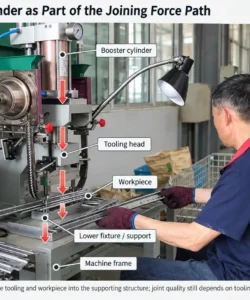
The frame and the tooling remain important regardless of actuator choice. An actuator can supply force and motion, but the machine structure, alignment, fixtures, controls, and safeguards must be suitable for the process. The discussion below therefore concerns selection principles, not a certified performance assessment of either photographed machine.
Why a hydro-pneumatic booster cylinder may fit a riveting press
In many pressing and joining tasks, the actuator travels toward the work before it encounters substantial resistance. The high-force portion of the operation may then be concentrated over a shorter travel interval. This distinction matters: a machine may require a comparatively long approach stroke without requiring maximum forming force over that entire distance.
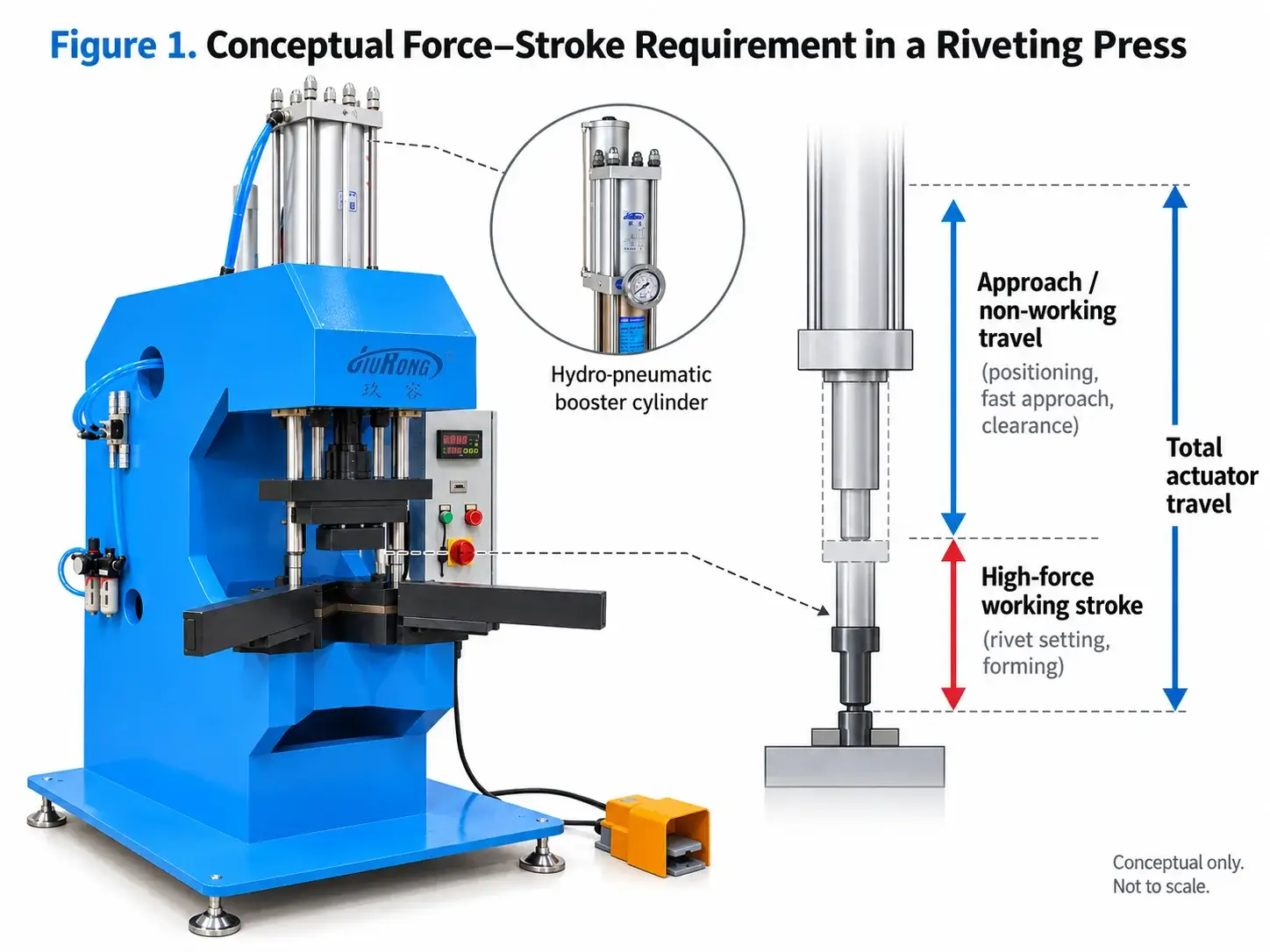
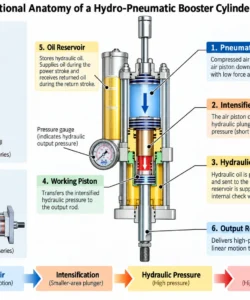
A hydro-pneumatic booster architecture uses compressed air and a hydraulic intensification stage to make higher working force available. For example, Air-Hydraulics describes its AH-series system as having a low-force approach followed by a hydraulically intensified power stroke; its published operation sequence uses valve-controlled stages. This is a useful demonstration of the principle, not evidence that the photographed machines use the identical mechanism or valve sequence. Actual switching behavior, permissible working stroke, and force-versus-position behavior depend on the specific cylinder and control design.
When the application calls for approach movement and a relatively short high-force operation, this architecture may offer a practical way to package the required function with compressed-air actuation. However, it should not be selected simply because the machine is described as a “riveting press.” If high force is needed through an extended portion of travel, if the cycle rate exceeds the configured system capability, or if sophisticated programmable force-position control is necessary, another architecture may be a better fit.
The force–stroke profile is the first selection document
A useful request for quotation separates the entire movement cycle into its relevant requirements. The buyer and machine designer should establish:
- Required process force: the validated maximum force and any significant force variation through the operation, including tooling and workpiece conditions.
- Total actuator stroke: the travel needed for tool clearance, approach, working contact, and return.
- High-force working stroke: the distance over which elevated process force is actually required—not merely the rated stroke printed in a catalog.
- Cycle and duty requirements: strokes per minute, operating hours, permitted dwell, thermal limits, and the intended duty cycle.
- Available utilities: actual compressed-air pressure and capacity at the machine, or available hydraulic/electrical infrastructure.
- Control and quality requirements: position tolerance, force regulation, changeover needs, monitoring, data retention, and pass/fail traceability where relevant.
The required load is not necessarily constant throughout the working stroke. Friction, material deformation, tooling geometry, and process sequence can change the force demand. Where process validation matters, a measured or experimentally established force–displacement profile is more useful than a single unqualified tonnage figure.
A catalog's nominal force is also not a guarantee of the force delivered at the workpiece under every operating condition. Pressure losses, actuator configuration, tool alignment, mechanical deflection, and the actual operating point must be considered. Likewise, pressure indicated by a gauge is not, by itself, a measured riveting-force record.
Three actuator architectures, compared on the same duty
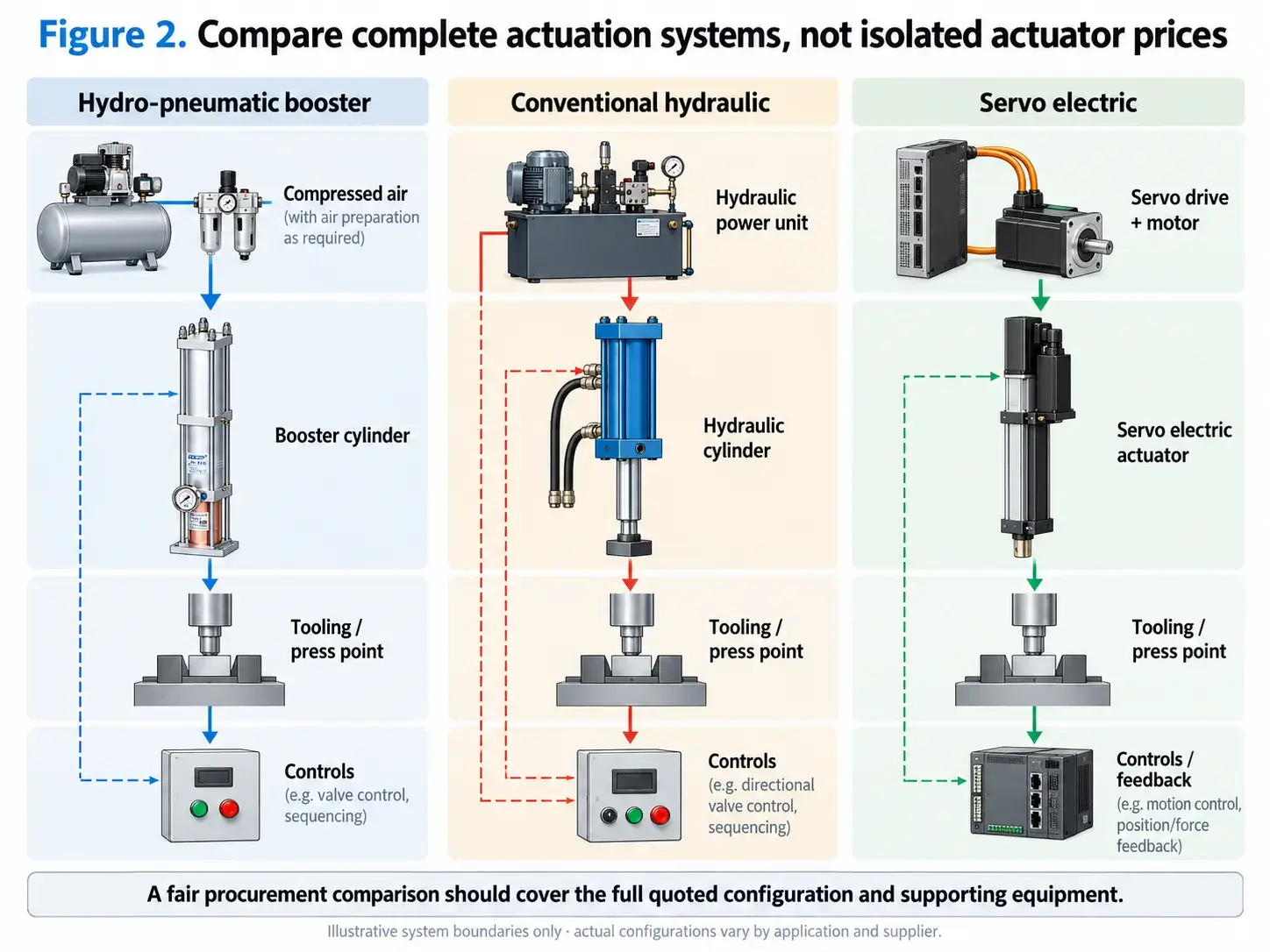
The meaningful comparison is not “Which cylinder is best?” It is “Which complete actuation system satisfies this press duty with acceptable cost, reliability, controllability, and risk?”
| Evaluation issue | Hydro-pneumatic booster | Conventional hydraulic actuation | Servo-electric actuation |
|---|---|---|---|
| Natural fit to investigate | Approach travel followed by relatively short high-force work, where the chosen unit's pressure, stroke, and frequency limits fit | High-force work over the required travel, especially where hydraulic infrastructure or fluid-power integration is appropriate | Applications needing programmed movement, flexible profiles, or force/position-based process evaluation |
| System provisions to include | Compressed-air supply, preparation, valves, intensifier/cylinder, controls, and relevant sensors | Cylinder, suitable hydraulic supply/power unit or shared circuit, valves, reservoir/lines as applicable, controls, and sensors | Electromechanical actuator, motor, drive, power supply, controls, and sensing/software required by the application |
| Main verification questions | Is the effective high-force stroke long enough? Can air supply support force and throughput? How is intensification controlled? | Can required force and speed be maintained over the needed stroke? What hydraulic circuit and power infrastructure are included? | Can the selected mechanics and motor meet peak/continuous loads, stroke, speed, and duty? What measurement and traceability are included? |
| Common purchasing mistake | Comparing only the self-contained actuator price while ignoring compressed-air infrastructure and duty requirements | Comparing the cylinder price without its hydraulic power and control scope—or charging for infrastructure already available | Comparing only the actuator price without drive and control scope—or paying for monitoring functionality that the process does not need |
These are conditional fit criteria, not performance rankings. For reference, Bosch Rexroth documents modular hydraulic power units with different motor, pump, and control configurations; its Smart Function Kit for pressing combines an electromechanical cylinder, servo drive, sensors, and software for programmed joining and process analysis. Features offered by one manufacturer or product family should not be assumed to exist in all systems using the same actuator technology.
A conventional hydraulic system is not automatically less precise, and a hydro-pneumatic system is not automatically devoid of process monitoring. Sensors and control packages can change the capability and price of any option. The requirement is to compare the actual quoted configuration, not labels assigned to entire technology classes.
What “cost-effective” should mean to a purchaser
The cheapest actuator quotation may not represent the lowest-cost working press. A fair comparison begins with a common technical scope: identical required force, working travel, cycle target, process quality criteria, safety/interface scope, installation conditions, and service expectations. Only solutions that satisfy those requirements should proceed to economic comparison.
At minimum, purchasing and engineering should compare the total installed system cost: the actuator, supporting power or air equipment, controls, valves and sensors, mounting and guarding interfaces, integration labor, commissioning, and any infrastructure upgrades needed. If a factory already has an appropriate utility or a shared power system, record that condition explicitly instead of assuming every project starts from zero.
Then compare total cost of ownership (TCO) over a defined operating period. Relevant elements include the cost of compressed air or electricity under the actual production duty, routine maintenance, seals and service parts, repair accessibility, expected replacement components, downtime exposure, and changeover requirements. Where meaningful, include commissioning time, process scrap, and traceability costs—but do not estimate savings without production evidence.
A simplified decision equation is useful for structuring quotations:
Evaluated cost = installed system cost + operating and service costs over the chosen evaluation period + explicitly assessed implementation and downtime risk.
This is a framework, not a universal financial formula. The cost categories must be consistently defined to avoid double counting, and risk should be treated transparently rather than disguised as a fabricated monetary figure. No evidence supplied for this job establishes a universal price ordering between the three actuator options, nor a reliable efficiency percentage for the machines shown.
A realistic procurement question
Consider a machine builder requesting quotations for a press advertised as a particular tonnage. If the tooling requires high force for only a short working interval, available compressed air is sufficient, and the process does not require tightly programmed force–position trajectories, a hydro-pneumatic booster option deserves evaluation. If the force must be sustained over a substantially longer stroke, hydraulic options may become more natural. If controlled motion profiles, force–displacement recording, or frequent program changes are essential, a suitably specified servo-electric system may justify its additional hardware and integration scope.
These are hypothetical selection paths, not claims about measured performance or purchasing decisions for the photographed machines. The result cannot be chosen reliably until the builder supplies the actual force–stroke requirement and suppliers respond against the same operating assumptions.
How to ask suppliers for comparable quotations
Instead of requesting “a 30-ton cylinder,” provide a single duty sheet defining the workpiece and joining operation, required force at the tool, total and loaded stroke, operating speed and frequency, available air/electric/hydraulic services, installation envelope, allowable deflection and alignment conditions, safety/control interfaces, quality monitoring, and intended service regime. Ask each supplier to declare exclusions, assumptions, the required auxiliary equipment, maintenance provisions, acceptance-test method, and applicable performance limits.
For the C-frame machine in the supplied photos, the load path and possible frame deflection warrant attention; for the row of upright presses, accessibility, repeated setup, and utility distribution may matter. Those are design-review questions suggested by visible geometry, not verified deficiencies or performance characteristics of the photographed equipment.
The purchasing result should be a technically compliant system quotation with defined boundaries—not simply three competing prices beside the same nominal tonnage.
The decision
A hydro-pneumatic booster cylinder is worth considering for a riveting press when its particular force–stroke behavior, available air supply, frequency capability, control scope, and installation conditions match the task. Conventional hydraulics and servo-electric systems remain legitimate choices when the application asks for a different combination of travel, load, programmability, or process evidence.
The most cost-effective actuator is therefore the compliant solution with the most appropriate total system cost and acceptable lifecycle risk, not necessarily the one with the lowest cylinder price or the greatest advertised capability.
 Two Pressing Points, One Setup? What a Dual-Head Riveting Station Must Get Right
 Why a Booster Cylinder Fits the Punching Station of a Long Aluminum Profile Machine
 When Hydro-Pneumatic Booster Cylinders Fit Riveting, Clinching and Press-Fit Equipment
 What is a Hydro-Penumatic-Booster-Cylinder
Leave a Reply