Why a Booster Cylinder Fits the Punching Station of a Long Aluminum Profile Machine
A long aluminum profile punching machine can look like a machine that requires a large amount of power throughout its entire structure.That is not necessarily the right way to read the machine.
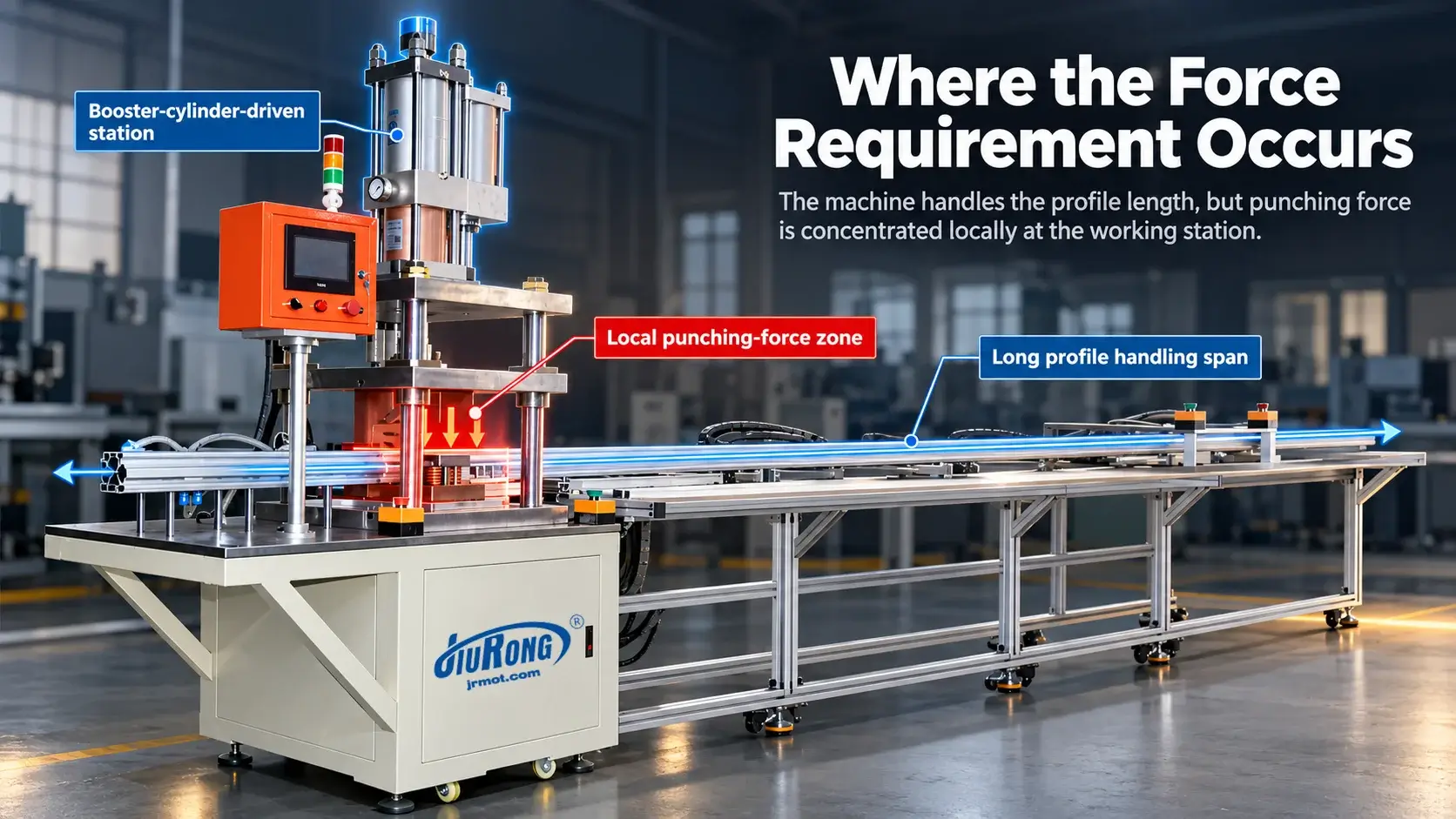
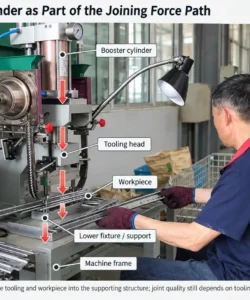
Much of its length exists because the workpiece is long. The machine has to support, guide, move and position the aluminum profile along the processing path. The actual high-force operation, however, takes place at a much smaller area: the punching station.
That distinction is important when choosing the actuator.For a process in which higher force is required mainly at the local punching point, a hydro-pneumatic booster cylinder can be a natural architecture to consider.
A Long Machine Does Not Mean High Force Is Needed Everywhere
The physical size of a machine and the location of its force demand are two different engineering questions.
In a long-profile machine, much of the overall structure is associated with the workpiece:
- supporting the profile;
- maintaining its path through the machine;
- moving it toward the working position;
- positioning the required section under the tooling.
The punching operation itself occurs locally.
This means the actuator does not need to apply punching force along the whole machine length. Its job is concentrated around the tooling and the mechanical event in which the punch engages the workpiece.
That changes the actuator-selection question from: “How do we power a very long machine?” to: “What actuator architecture best serves the local punching station?”
What the Punching Station Actually Needs
In this type of punching application, the actuator requirement can involve two distinct phases.
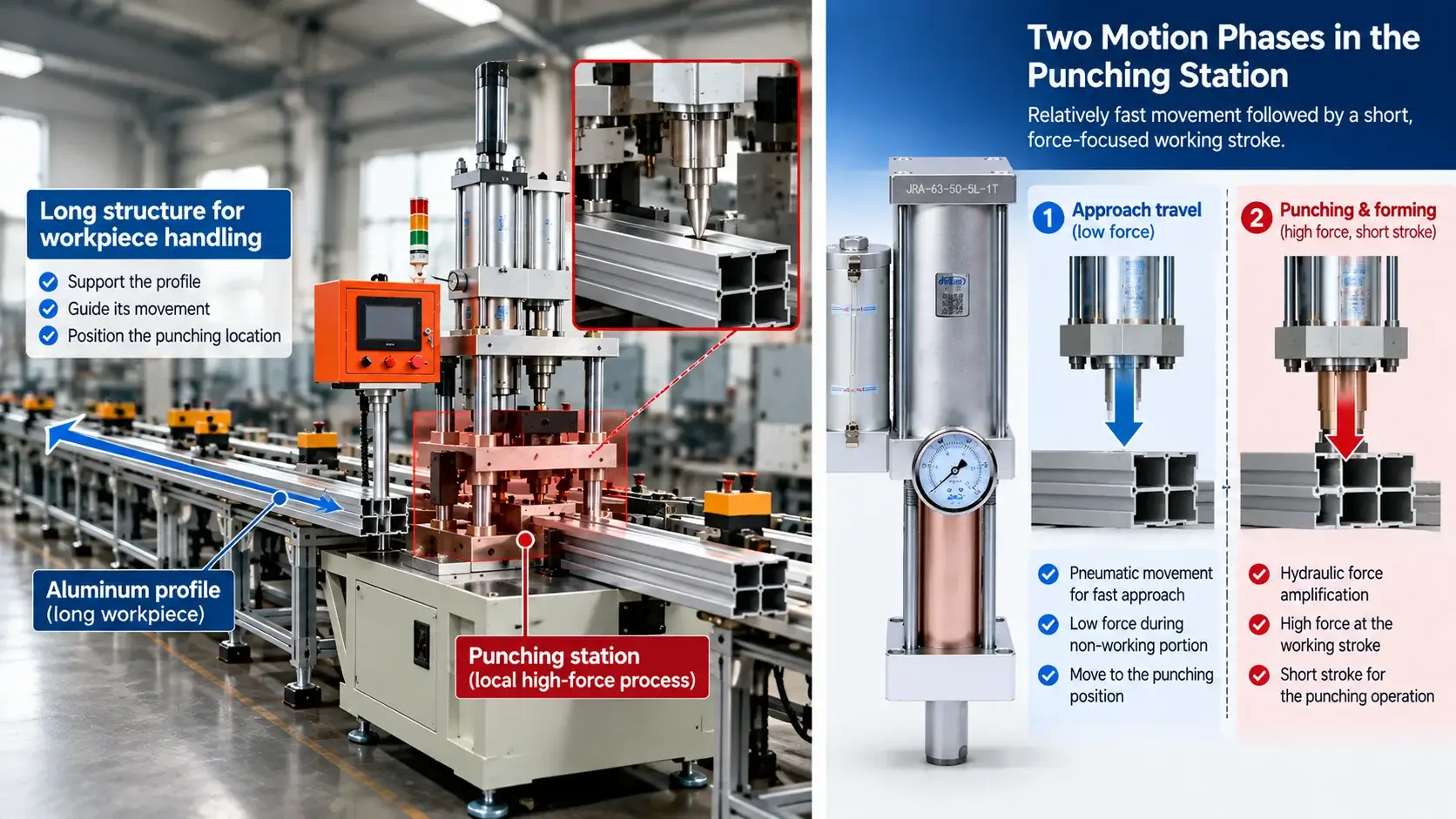
The first is movement toward the workpiece.
The second is the force-producing portion of the cycle, where the tooling performs the actual work.
Those two phases do not necessarily require the same force.
This is the engineering condition that makes a booster-cylinder architecture relevant.
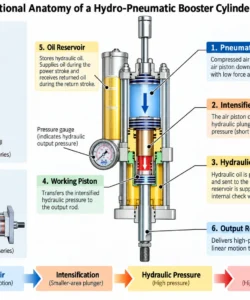
A hydro-pneumatic booster cylinder combines pneumatic movement with a hydraulic force-amplification stage. In an appropriate application, the actuator can move through the non-working portion of the stroke and provide higher force during the shorter working portion where the tooling encounters resistance.
The important point is not simply that the cylinder can produce “high force.”
The more useful question is:
Where in the machine is that force required, and for how much of the motion?
For a localized punching station, that distinction can matter more than the total physical size of the equipment.
Why This Working Pattern Matches a Booster Cylinder
Fast movement and a force-focused working stroke
A booster-cylinder system is particularly relevant when the process does not require maximum force throughout the entire actuator stroke.
The actuator can approach the working area before the force-amplification phase becomes important.
This creates a useful separation between:
- movement required to reach the workpiece; and
- force required to perform the punching operation.
For machine designers, this means actuator selection can be based on the actual force profile of the station rather than treating every millimeter of actuator travel as a maximum-force event.
The long profile may extend far beyond the punching head, but the deformation event remains local. The workpiece-support and handling structure manages the length of the profile, while the actuator serves the local working load.
This separation can also be useful in non-standard machine layouts where the force-producing actuator must be integrated around the tooling, workpiece access and surrounding station components.
A booster cylinder therefore does not need to “power the long machine.” Its role is to serve the localized punching process within that machine.
What the Booster Cylinder Does Not Solve
It is equally important to separate the actuator's role from the performance of the entire machine.
The booster cylinder does not by itself determine:
- aluminum-profile positioning accuracy;
- feed accuracy;
- hole-position accuracy;
- tooling alignment;
- frame rigidity;
- guide accuracy;
- fixture quality;
- workpiece support;
- control-system accuracy;
- complete machine cycle time.
Those functions depend on the rest of the machine architecture.
For example, accurate punching locations depend on how the profile is positioned and controlled before the punch operates. Tool life and hole quality depend strongly on the punch, die, alignment and material conditions. Machine stability depends on the frame, guides, fixtures and reaction-force path.
The actuator contributes force and motion to the punching station.
It should not be used as an explanation for every performance characteristic of the machine.
When Another Actuator Architecture May Be More Appropriate
A booster cylinder is most meaningful when its force profile matches the process.
If an application requires high force over a long continuous stroke, substantially different motion profiles, sophisticated programmable force-position control, or another operating pattern that does not match a short force-focused event, other actuator architectures may deserve evaluation.
Depending on the machine requirement, these may include:
- conventional hydraulic cylinders;
- servo-electric cylinders;
- servo-hydraulic systems;
- other specialized press or punching architectures.
The correct question is therefore not:
“Is a booster cylinder better than the alternatives?”
It is:
“Does the force-and-motion requirement of this punching station match the operating characteristics of a booster cylinder?”
What Should Be Confirmed Before Selection?
Before selecting a booster cylinder for a long aluminum profile punching machine, the machine designer should establish at least the following inputs:
- required punching force;
- total actuator stroke;
- required high-force stroke;
- available compressed-air pressure;
- required operating frequency;
- tooling and fixture arrangement;
- mounting space and orientation;
- mechanical reaction-force path;
- required control method;
- required positional or process repeatability.
These inputs define whether the actuator architecture is appropriate and how the cylinder should be sized.
Without them, a product category may appear suitable while the actual configuration remains unresolved.
The Engineering Reason the Architecture Makes Sense
The important selection principle is to evaluate the actuator against the force-and-motion profile of the punching station rather than against the physical length of the machine.
When higher force is concentrated in a short, localized working phase, a hydro-pneumatic booster cylinder becomes a logical actuator architecture to evaluate—provided the actual force, stroke, air supply, duty cycle, mounting and control requirements support that choice.
 Two Pressing Points, One Setup? What a Dual-Head Riveting Station Must Get Right
 How to Choose a Cost-Effective Actuator for a Riveting Press
 When Hydro-Pneumatic Booster Cylinders Fit Riveting, Clinching and Press-Fit Equipment
 What is a Hydro-Penumatic-Booster-Cylinder
Leave a Reply