When Hydro-Pneumatic Booster Cylinders Fit Riveting, Clinching and Press-Fit Equipment
Riveting, clinching and press-fit assembly look like different processes, but many dedicated machines built for them share an important operating characteristic:
the machine does not need its highest forming force through the entire stroke.
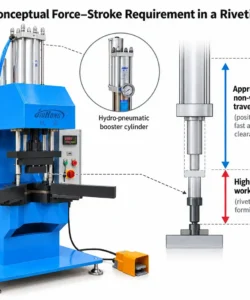
Before the tool reaches the workpiece, the actuator mainly needs to move into position. The demanding part comes after contact, when the rivet, fastener or sheet material must be deformed, seated or mechanically locked.
That difference between the approach stroke and the working stroke is one reason hydro-pneumatic booster cylinders can be a natural fit for dedicated joining equipment.
The important question is therefore not simply whether an actuator can produce enough force.
It is whether its operating behavior matches the force and motion profile of the process.
The process requirement changes during the stroke
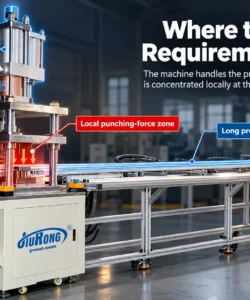
In the supplied riveting and press-fit applications, the joining head travels toward a localized working position where force is transferred through an upper tool, the workpiece and a lower die or fixture.
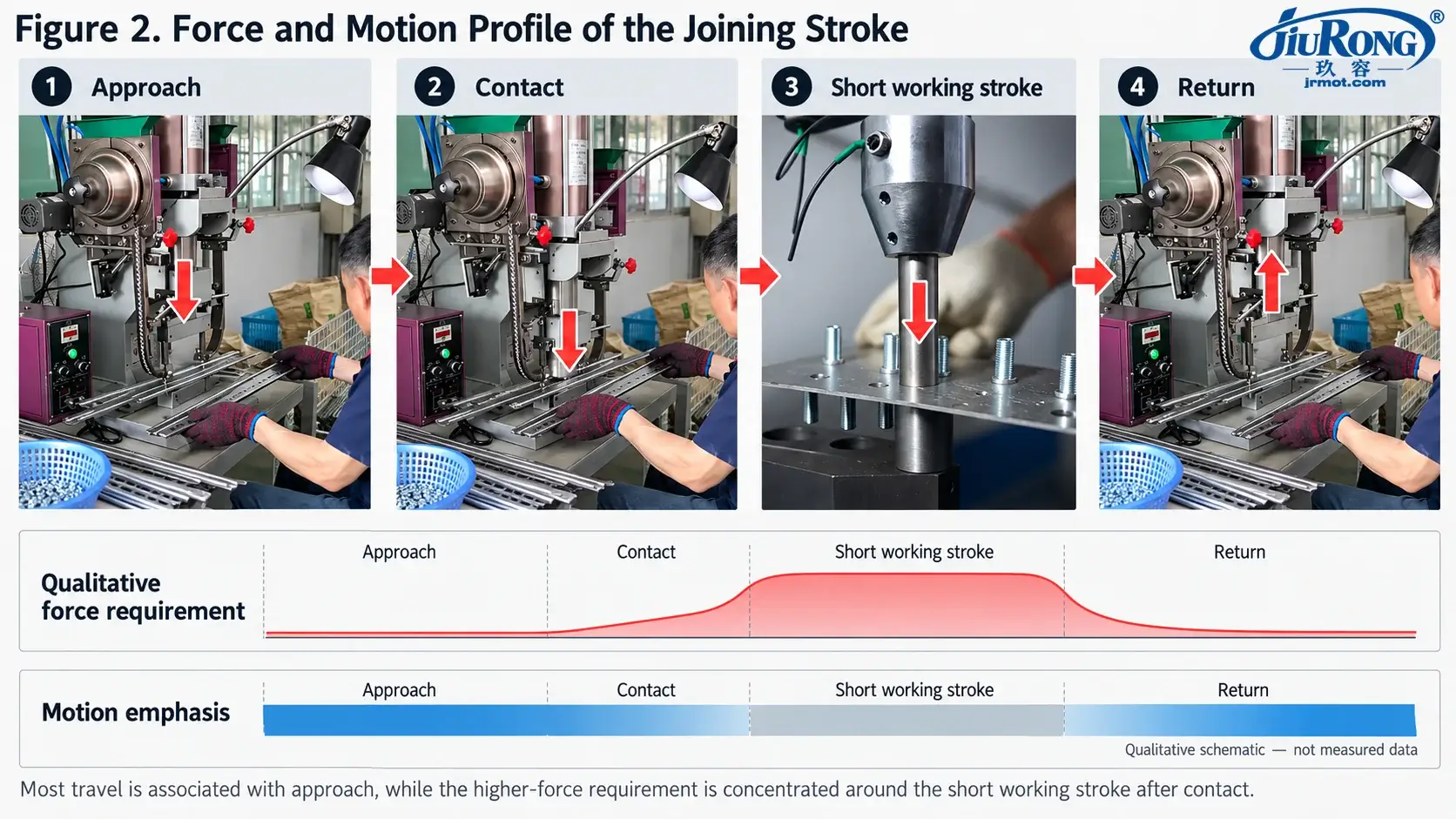
The complete movement can be understood in four stages:
- approach to the workpiece;
- tool contact;
- a relatively short forming or pressing stroke;
- return for the next cycle.
These stages do not impose the same force requirement.
During approach, the primary requirement is movement.
Once the tool reaches the workpiece, the requirement changes: the machine must generate enough force to deform, seat or mechanically lock the joint.
That is why actuator selection should be based on the force profile across the stroke, rather than only on the maximum force number.
Why a hydro-pneumatic booster architecture can match this profile
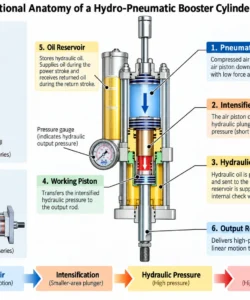
In a typical hydro-pneumatic booster-cylinder cycle, the actuator can combine a relatively fast approach phase with a boosted working phase.
This allows the higher-force action to be concentrated around the part of the cycle where forming actually occurs.
For riveting, clinching and press-fit machinery, that can create a practical operating match:
Fast approach → contact → short boosted working stroke → return.
A booster cylinder is relevant here not simply because it can generate high force, but because that force can be concentrated into the short part of the stroke where the joining operation takes place.
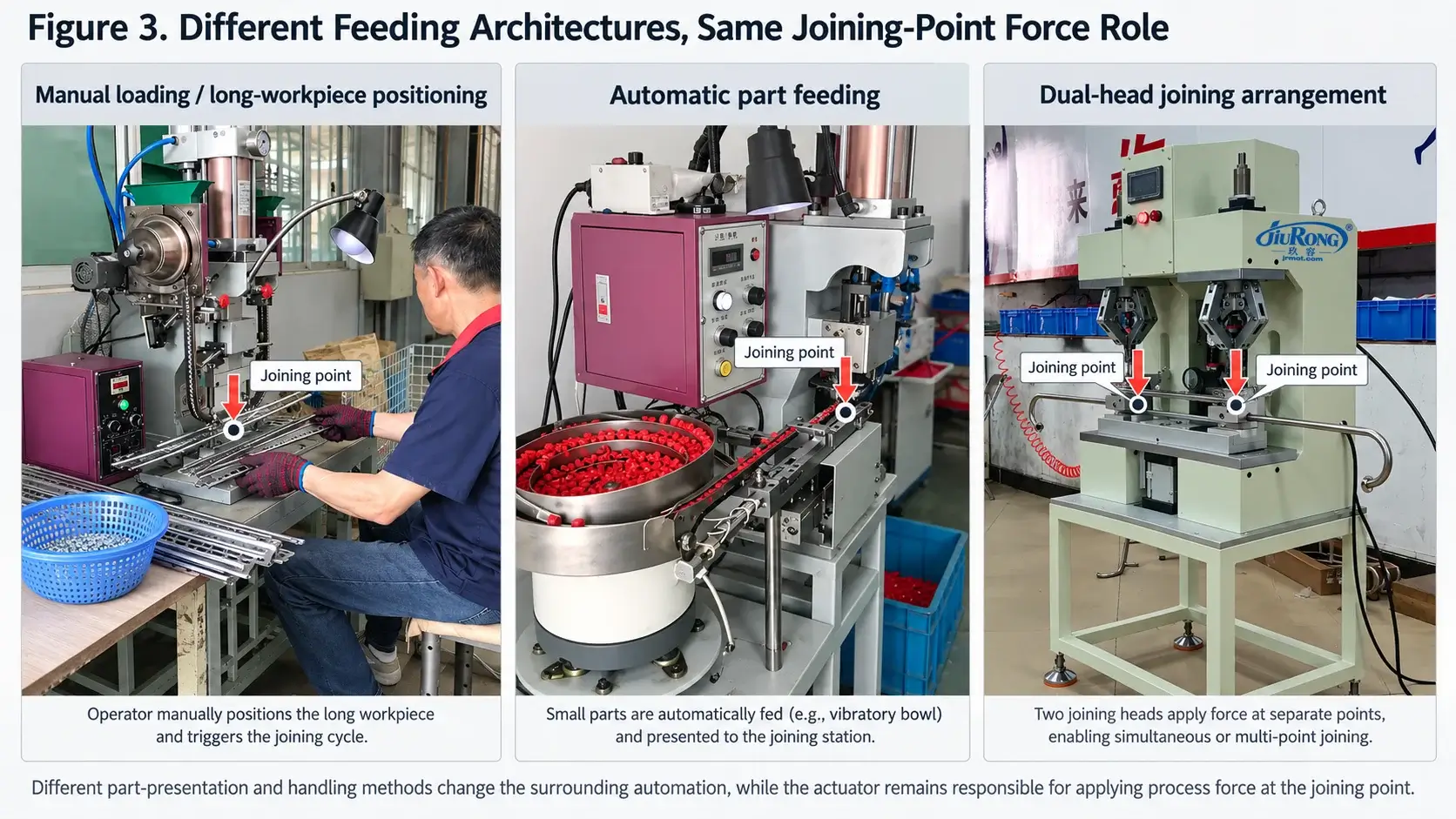
The supplied examples include manual workstations, automatic feeding equipment, multi-head arrangements and larger press structures. Their surrounding automation changes, but the actuator remains positioned at the point where the joining force must be generated.
The cylinder is only one part of the force path
A booster cylinder can generate the process force, but it does not independently determine the quality of the completed joint.
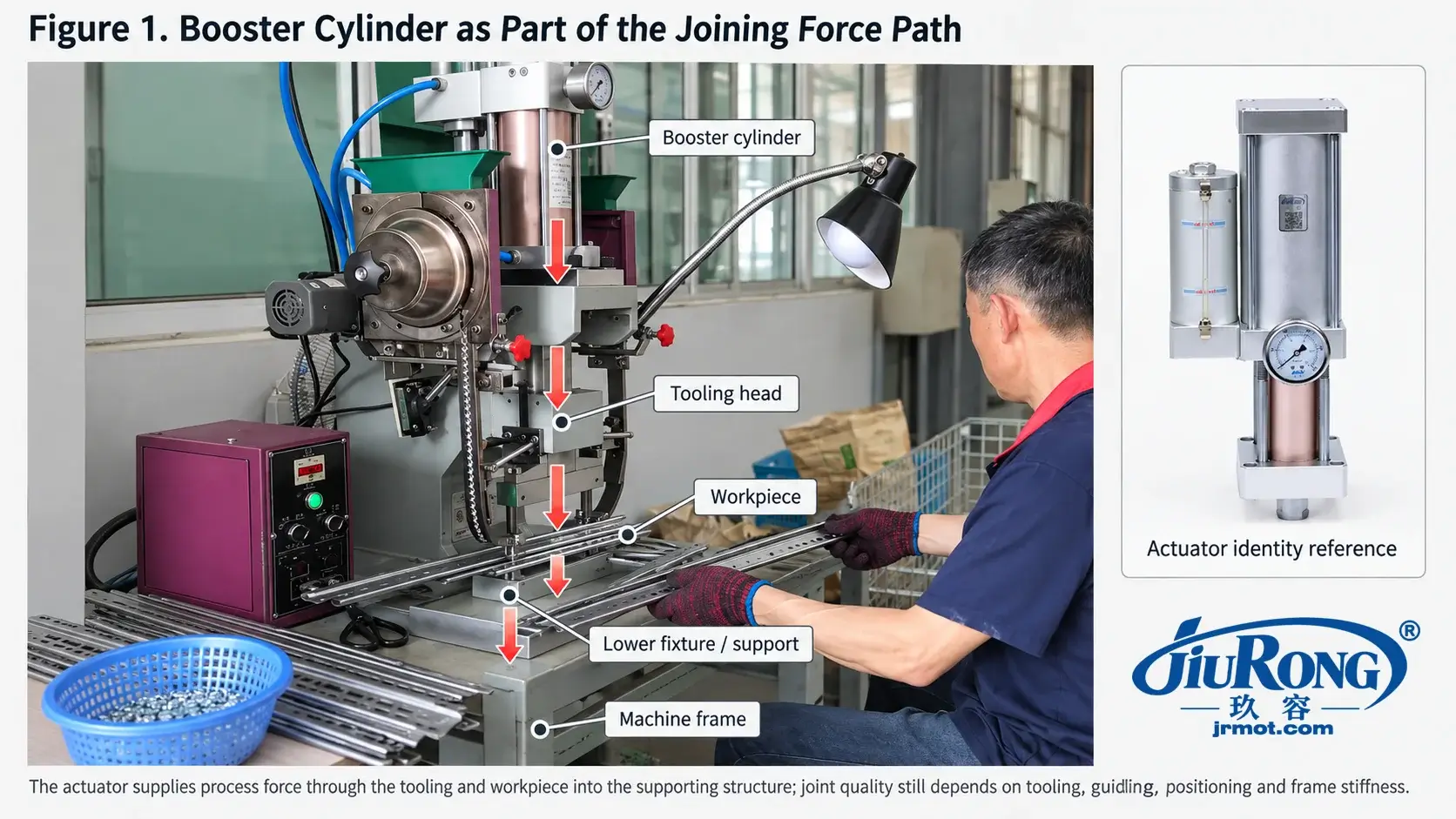
The force still has to pass through the complete machine structure:
actuator → moving tooling → workpiece → lower tooling → machine frame.
This makes several machine-level elements important.
- Tooling determines how the force is transferred into the rivet, fastener or sheet material.
- Guiding helps keep the moving tool aligned instead of asking the cylinder rod to manage significant side load.
- Workpiece positioning determines whether the force is applied at the intended joining location.
- Frame stiffness affects how well the machine maintains the relationship between the upper and lower tools under load.
- Mechanical travel control can be important where the process depends on a controlled final forming position.
This is especially visible in the supplied machines that use guide columns, dedicated tooling blocks, fixtures and substantial machine frames around the cylinder.
The professional implication is important:
selecting the actuator is not the same as designing the joining process.
The booster cylinder supplies force within a larger mechanical system.
Different feeding systems can lead to the same joining requirement
The supplied machines use different handling methods—from manual loading and long-workpiece positioning to vibratory feeding and multi-head arrangements.
These systems change how the part reaches the joining station, but not the underlying force requirement once the tool reaches the workpiece.
The distinction is simple:
feeding solves part presentation; the actuator supplies the process force at the joining point.
This is why similar actuator principles can appear in machines that otherwise look very different.
Why this does not make the booster cylinder a universal answer
A hydro-pneumatic booster cylinder is one actuator architecture, not a general replacement for hydraulic or servo systems.
A conventional hydraulic cylinder may be a natural choice when the machine architecture already includes hydraulic power, or when the process requires a different relationship between force and travel.
A servo press or servo electric cylinder may become more appropriate when the process depends heavily on programmable motion profiles, controlled position, force-displacement monitoring or production traceability.
Even a pneumatic cylinder may be sufficient when the required force is modest enough that there is no reason to introduce a boosted stage.
So the meaningful selection question is not:
“Which actuator technology is best?”
It is:
“What force, motion and control profile does this joining process actually require?”
For a dedicated riveting, clinching or press-fit station that requires relatively fast approach and a short high-force forming stroke, a hydro-pneumatic booster cylinder can be a logical architecture to evaluate.
That is the engineering fit demonstrated by these application examples.
 Two Pressing Points, One Setup? What a Dual-Head Riveting Station Must Get Right
 How to Choose a Cost-Effective Actuator for a Riveting Press
 Why a Booster Cylinder Fits the Punching Station of a Long Aluminum Profile Machine
 What is a Hydro-Penumatic-Booster-Cylinder
Leave a Reply