Two Pressing Points, One Setup? What a Dual-Head Riveting Station Must Get Right
Consider a component that needs two mechanical connections. The pressing operation at each point may be straightforward, yet producing both connections on the same part introduces another challenge: the second joint must be positioned correctly relative to the first.
If the process requires an operator to release the part, shift it and locate it again, the second setup becomes part of the manufacturing problem. A two-head machine offers a different equipment layout, but the presence of two workheads does not by itself solve that problem. What matters is how both operations are organized around the workpiece.
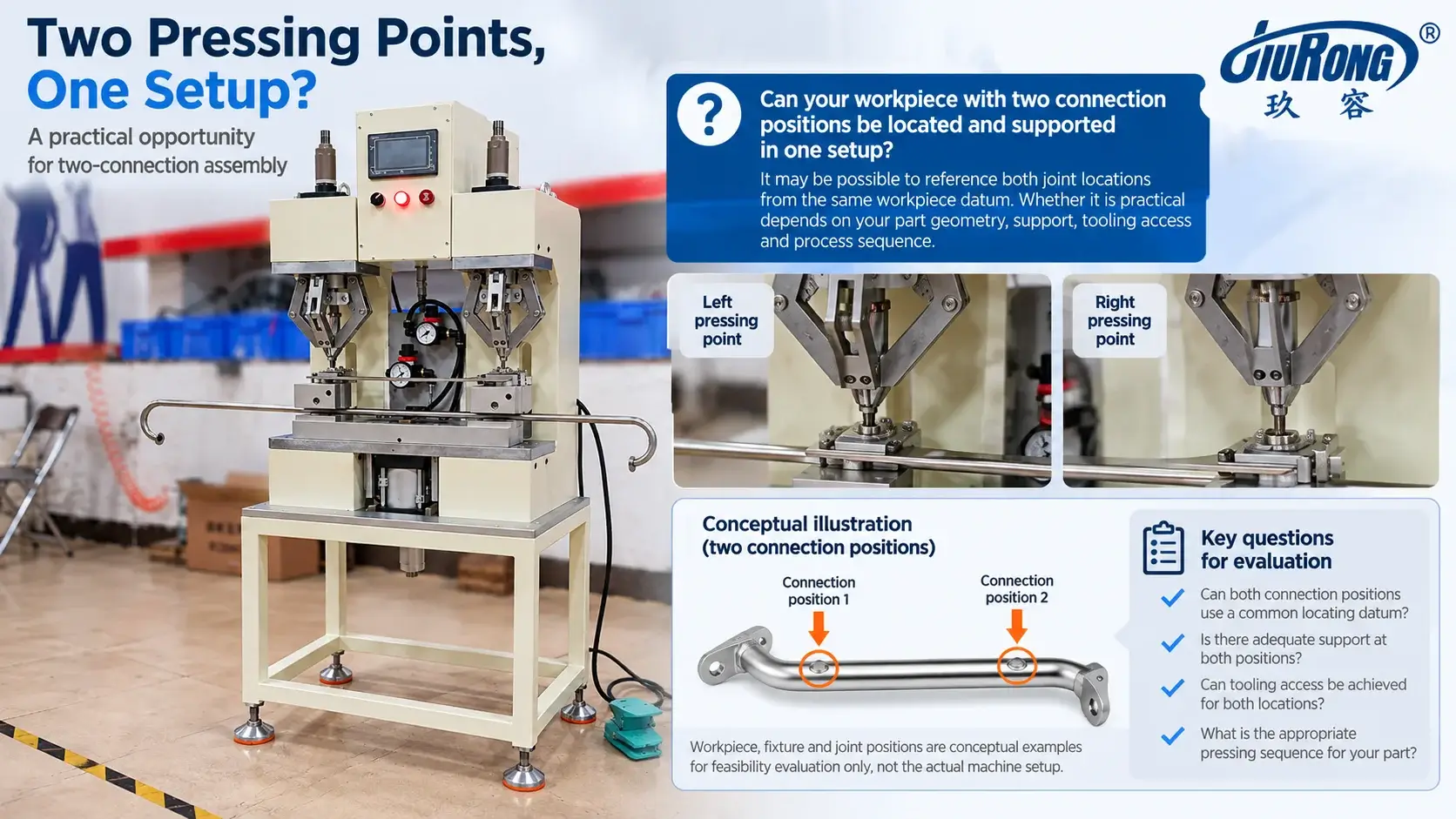
JiuRong Automatic multi-head press riveting machine has two adjacent upper heads, tooling locations below them, a central control interface, pressure-related components and a foot control. Those are visible configuration details. They do not establish whether the heads operate together, whether their settings can be controlled independently, or whether fasteners are supplied automatically.
The real design question is the shared reference
For two connections on one part, their relative positions usually have to be judged against the part drawing. A common fixture can provide a repeatable reference, but only if it locates the relevant features and supports the part near the processing points.
A long or flexible part may need support that prevents unwanted movement or deflection under the pressing load. An irregular component may require dedicated nests, stops or clamps. For some applications, one fixed datum works for both heads; for others, head spacing, tooling access or part geometry may prevent a useful shared setup.
This is why “two heads” should not be treated as a substitute for fixture design. Before choosing the architecture, an engineer should specify the two joint coordinates, their allowable relative variation, the part's support surfaces and how the component will be placed and removed.
Two tool sets must produce two acceptable joints
Each position needs tooling appropriate to its fastener, material stack and finished-joint requirement. The force and displacement applied by the working head must be transferred through the intended joint, not through unsupported or vulnerable areas of the part.
If both connections are nominally identical, their tooling may be similar; that still does not prove both positions will behave identically when the support geometry differs. If the two points require different forming conditions, the equipment must be assessed for the control needed at each position. A pressure gauge or adjustment device in a photograph is not proof of independently monitored joint force.
A practical evaluation should therefore include representative samples at both locations. Inspect the joint geometry and relevant acceptance criteria at each point, and check whether forming one connection influences alignment or support for the other.
Simultaneous and sequential cycles are different engineering proposals
Two workheads can, in principle, be coordinated in different ways. They might move together, act one after the other, or follow an application-specific sequence. The photograph does not disclose the actual sequence for this machine.
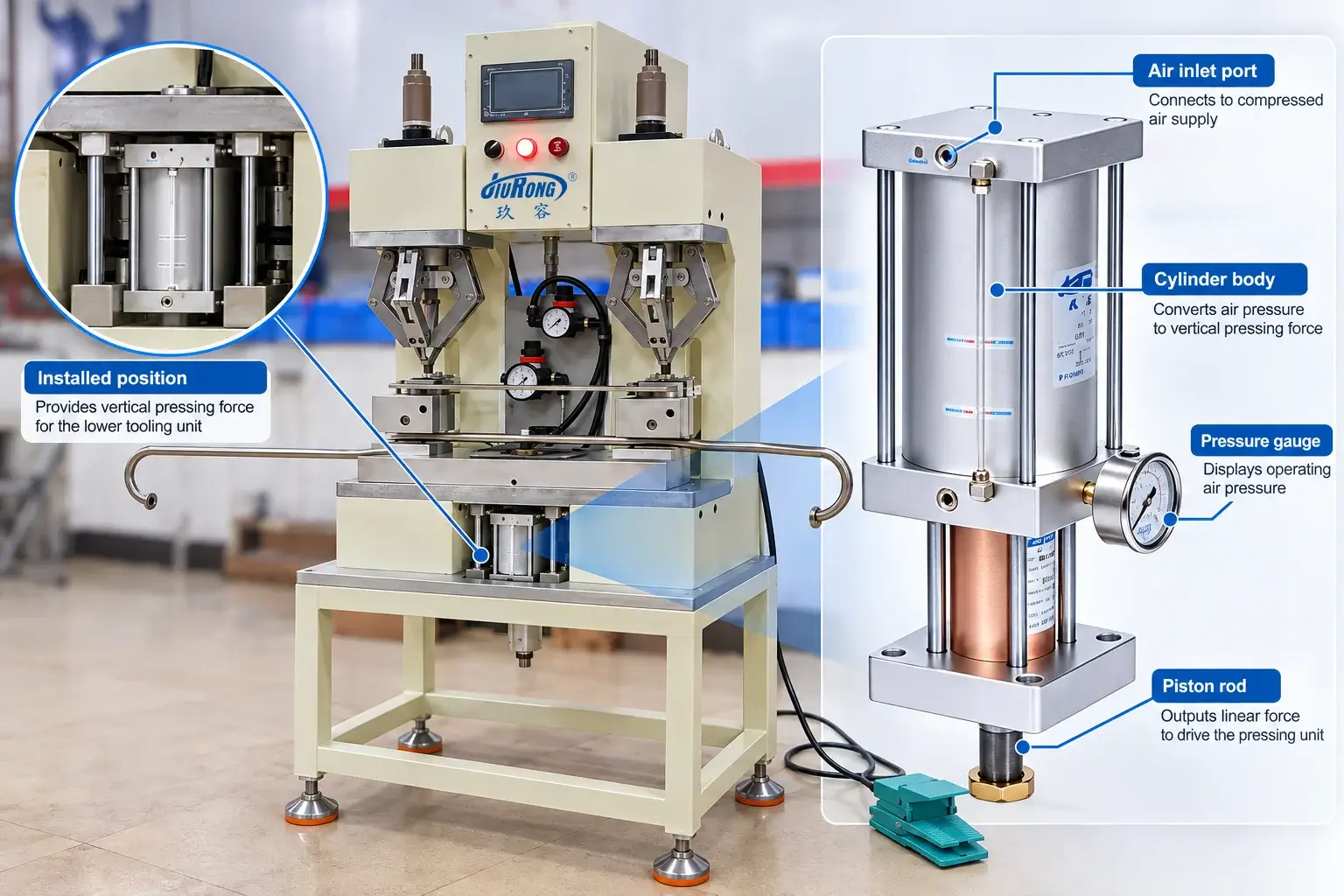
The distinction matters. A simultaneous cycle may place loads into two regions of the workpiece at once and require sufficient support for the combined loading condition. A sequential cycle may change how the component reacts after the first connection is formed. Depending on part stiffness, the order of operation may affect the final fit and location of the second connection.
Neither arrangement is automatically superior. The appropriate sequence follows the joint requirements and test results. Buyers should request a demonstrated cycle with the intended workpiece, rather than assume that two visible heads equal one simultaneous stroke.
How to evaluate the complete cycle
Reducing repositioning can matter more than shortening an individual pressing stroke. A credible trial measures the complete operation: loading, locating, any fastener presentation, both working actions, inspection and unloading. Where appropriate, changeover and jam recovery also need consideration.
For a candidate dual-head machine, a useful acceptance review asks:
- Can the workpiece be located with a consistent datum for both required joint positions?
- Are the two positions accessible and adequately supported throughout the intended sequence?
- Do the individual tool sets match the fasteners, material thicknesses and specified finished joints?
- Is the head sequence simultaneous, sequential or otherwise controlled, and how is it confirmed?
- What happens if one point is misaligned, a fastener is absent, or a joint fails an acceptance check?
- What is the measured complete-part cycle on representative samples, including handling and inspection?
These questions define whether the proposed setup fits the production requirement. They do not imply that the pictured machine already implements each feature.
A dual-head machine is an application-specific assembly choice
A two-position layout becomes meaningful when the workpiece truly needs two operations and a common positioning strategy is feasible. It can be attractive to investigate where repeated release and relocation are a major part of the current work. But multiple heads also bring fixture, access and sequencing constraints that must be resolved before a production advantage can be claimed.
The useful buying question is therefore not “How many heads does this machine have?”
It is:
Can both connections be formed and verified against the same workpiece requirements within a practical, validated setup?
 How to Choose a Cost-Effective Actuator for a Riveting Press
 Why a Booster Cylinder Fits the Punching Station of a Long Aluminum Profile Machine
 When Hydro-Pneumatic Booster Cylinders Fit Riveting, Clinching and Press-Fit Equipment
 What is a Hydro-Penumatic-Booster-Cylinder
Leave a Reply