Wide-Format Sheet and Film Processing with Dual-Servo Electric Cylinder Technology
Wide-format sheet and film processing operations typically demand the integration of multiple sequential functions—material feeding, accurate positioning, clamping, controlled vertical processing, release, and indexed advancement—into a single continuous production cycle, and the Dual-Servo Electric Cylinder Sheet Feeding, Pressing and Cutting Machine consolidates these operations within one automated platform.
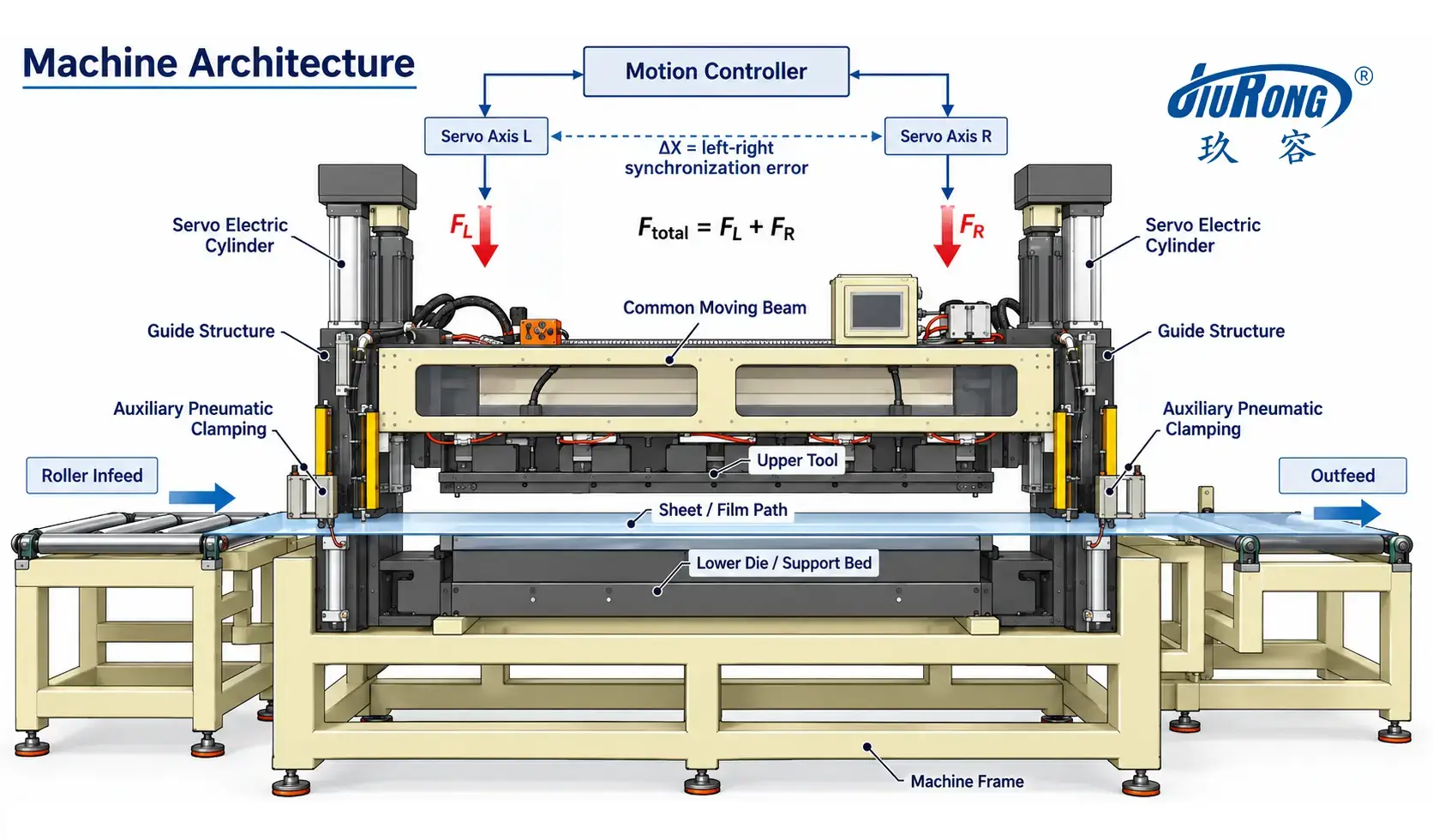
The machine employs a roller feeding section to transport material through the system, while pneumatic devices handle positioning and clamping functions. At the main processing station, two servo electric cylinders drive a common wide moving beam, enabling installed tooling to execute pressing, forming, punching, die cutting, or press cutting operations.
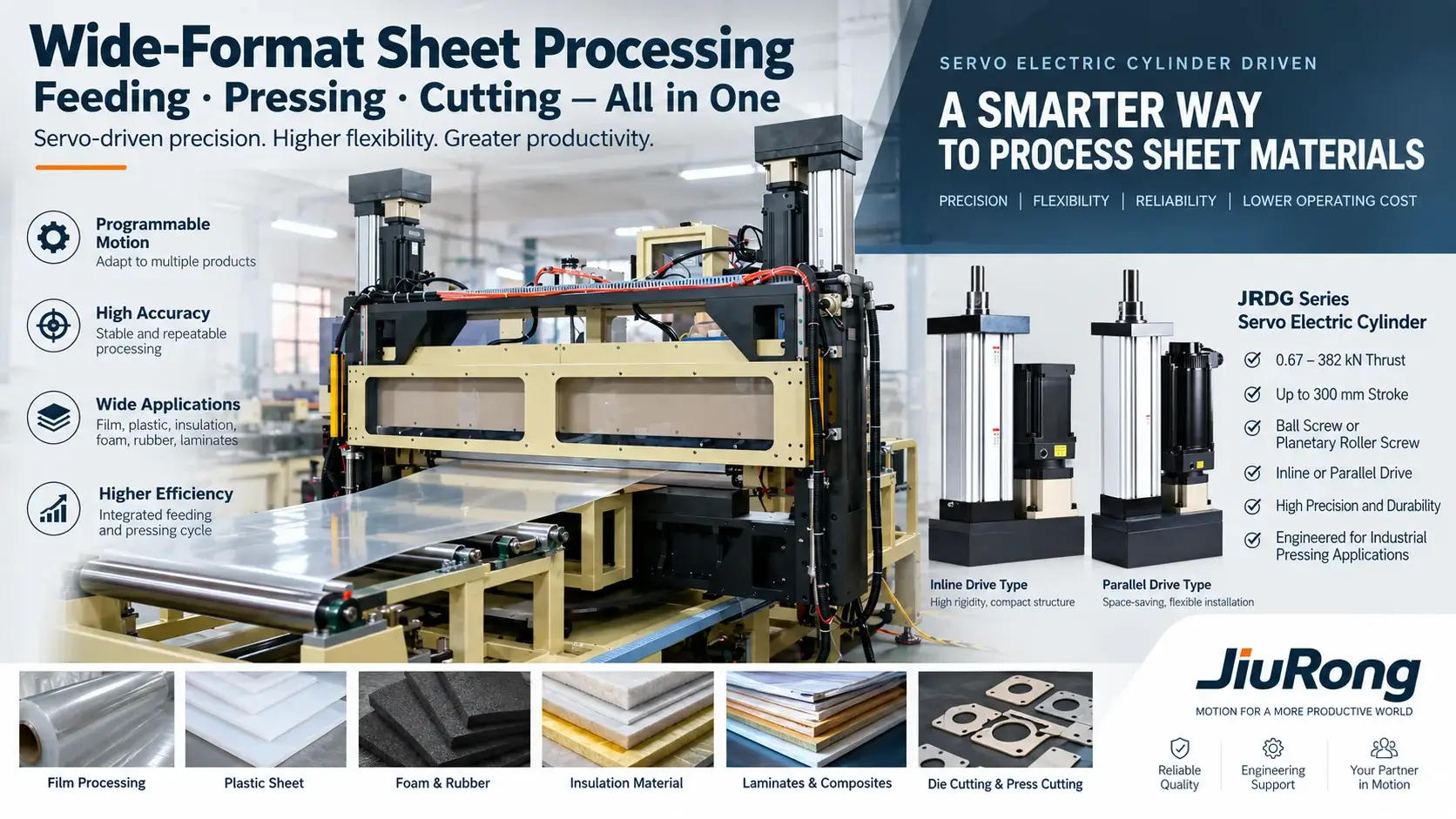
The dual-servo architecture proves particularly advantageous as working width increases: rather than concentrating all process force through a single central point, two synchronized actuators drive the beam from both sides, maintaining more stable working geometry across the full width while keeping the process stroke fully programmable.
For manufacturers processing industrial film, plastic sheet, insulation material, laminated composite, foam, rubber sheet, and similar wide-format materials, this machine represents not merely an electric alternative to conventional presses, but a programmable processing platform that unifies material handling and controlled pressing motion within one production cycle.
Machine Function Overview
The machine addresses applications where sheet-type materials must progress through a repeated processing sequence. A typical cycle encompasses material feeding, indexed positioning, pneumatic clamping or stabilization, controlled vertical approach, pressing/forming/punching/cutting, beam return, material release, and advancement to the next processing position. The actual operation is determined by the tooling installed in the working area; the same basic machine architecture can accommodate press-cutting tools, forming dies, compression tools, or punching tools, provided that the required force, stroke, speed, rigidity, and cycle rate fall within the machine design limits. This flexibility represents a primary advantage of servo-controlled architecture, as machine motion can be adapted to product and process requirements rather than forcing every product to conform to a fixed mechanical stroke.
Production Cycle Sequence
Material Feeding
Sheet material enters through the roller infeed section, and depending on line configuration, the feeding system advances the material by a programmed length or processing pitch—a critical feature for applications where consistent spacing between consecutive cuts, holes, formed areas, or pressed sections must be maintained.
Positioning
Upon reaching the programmed feed length, the material is brought into the processing position. The positioning stage may incorporate mechanical stops, sensors, feed-roll control, or other locating methods depending on product specifications.
Clamping and Stabilization
Pneumatic devices secure the material before the vertical processing stroke commences, preventing sheet shifting when the tool contacts the material. For flexible or semi-rigid materials, this step is particularly critical as the material itself may lack sufficient stiffness to maintain position under tool contact.
Fast Approach
The two servo electric cylinders move the common beam toward the workpiece; the non-working portion of the stroke can be completed relatively quickly since the entire cycle need not run at process speed.
Controlled Working Stroke
As the tool approaches the material, motion transitions to a controlled process speed. Depending on tooling configuration, this cycle phase can perform:
- pressing
- compression
- forming
- punching
- die cutting
- press cutting
Return
Upon completion of the process stroke, the two servo axes retract the beam, material is released, and the feeding system advances it to the next programmed position. The cycle then repeats. The architecture's value lies in coordinating these functions as a unified sequence rather than treating feeding, positioning, and pressing as unrelated operations.
Rationale for Dual-Servo Electric Cylinder Configuration
The defining mechanical feature of this machine is not simply the use of servo electric cylinders, but the deployment of two such actuators to drive a single wide moving beam. A wide beam presents mechanical challenges distinct from those of a narrow press head: when a process tool spans a large working width, the machine must maintain left-right parallelism, stable tool engagement, controlled force distribution, sufficient rigidity, and resistance to eccentric loading. Deploying two actuators positions the drive force closer to both sides of the moving beam. In simplified form:
where
Synchronization in Wide-Format Processing
Two actuators deliver improved machine performance only when they move in unison; if one side advances ahead of the other, the beam tilts. For a wide tool, even a small left-right displacement difference can affect tool engagement across the working width. The synchronization relationship can be expressed as:
where
Process Capabilities
The machine architecture supports a range of sheet and film processing operations, with final capability determined by installed tooling and process requirements.
- Pressing: The machine applies a controlled vertical stroke for compression, seating, flattening, or consolidation of materials where repeatable closing position and controlled approach speed are more critical than impact energy.
- Forming: With appropriate tooling, the servo-driven beam performs controlled forming operations on materials that do not require the extremely high energy of conventional mechanical stamping presses; programmable stroke and speed allow motion adaptation to different forming stages.
- Punching: The machine supports punching operations where peak load, tool geometry, machine stiffness, and cycle rate are compatible with the actuator system's capabilities.
- Die Cutting: For industrial film, insulation material, foam, rubber sheet, laminated material, and other sheet products, the machine uses press-type cutting dies that close vertically rather than employing guillotine-style blade cutting—one of the more natural applications for a wide synchronized beam.
- Press Cutting: Where products require cutting across a controlled width or profile under vertical load, the machine can be configured as a press-cutting station, with the process coordinated to indexed feeding so each new material section is positioned automatically before the next cut.
Applicable Materials
The machine is best suited to materials supplied as sheets, strips, or continuous web-like products requiring repeated processing over defined pitch or area intervals.
Industrial Film and Polymer Sheet
Suitable processes include profile cutting, repeated punching, compression, forming, and indexed press cutting. The programmable feed distance and servo working stroke are particularly useful when different product dimensions are handled on the same machine.
Insulation Materials
Insulation sheets often require stable positioning and uniform tool engagement across a relatively wide area. Applications include cutting, punching, compression, forming, and repeated profile processing.
Foam and Rubber Sheet
Foam and rubber materials can deform easily before and during tool contact; controlled approach speed and stable clamping help reduce movement during processing. Depending on material and die design, the machine can be configured for pressing or die cutting.
Laminated and Composite Sheet
Layered materials typically require controlled closure rather than simple impact strokes. Servo motion is advantageous when processes depend on programmed position, controlled speed, repeatable closing depth, and adjustable dwell.
Semi-Rigid Sheet Products
For materials with greater stiffness than thin film but still processed in sheet form, the machine combines indexed feeding with pressing, punching, or forming. Material capability depends on required force, cutting resistance, thickness, tooling design, and process speed.
Advantages of Servo Motion Control
The principal advantage of the servo electric cylinder lies not in replacing hydraulic oil, but in making press movement fully programmable. A typical motion profile can be divided into:
rapid approach --> controlled contact --> process stroke --> hold --> return
Each section can employ different motion parameters, allowing the machine to move quickly where speed is beneficial and slow down where process control is required. For example, the beam can approach rapidly, decelerate before tool contact, complete the working stroke at a lower controlled speed, hold position if dwell is required, and retract quickly after the operation. This improves cycle design by eliminating the need to run the entire stroke at one fixed speed, and also streamlines changeover. When a new product requires different working height, feed length, pressing depth, approach distance, or process speed, these values can often be adjusted through the motion recipe rather than requiring extensive mechanical adjustment—a particularly valuable feature for manufacturers producing multiple product variants on one line.
JiuRong's electric-cylinder platform is based on servo-driven electromechanical actuation, where rotary motor motion is converted into linear movement through a ball screw or planetary roller screw, enabling position, speed, and thrust-related motion to be precisely controlled through the servo system.
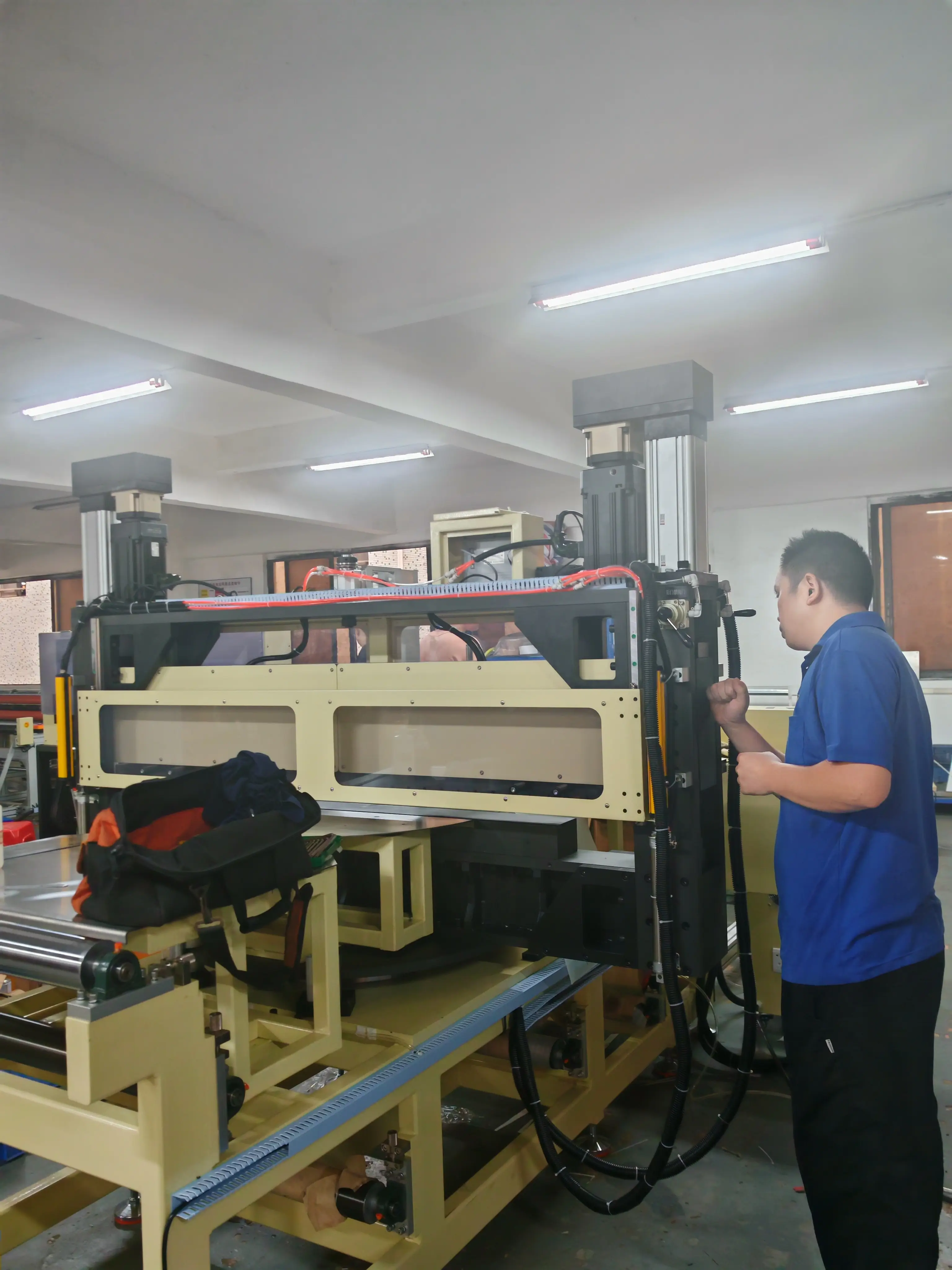
Wide Format Sheet Film Processing with Dual Servo Electric Cylinder Technology
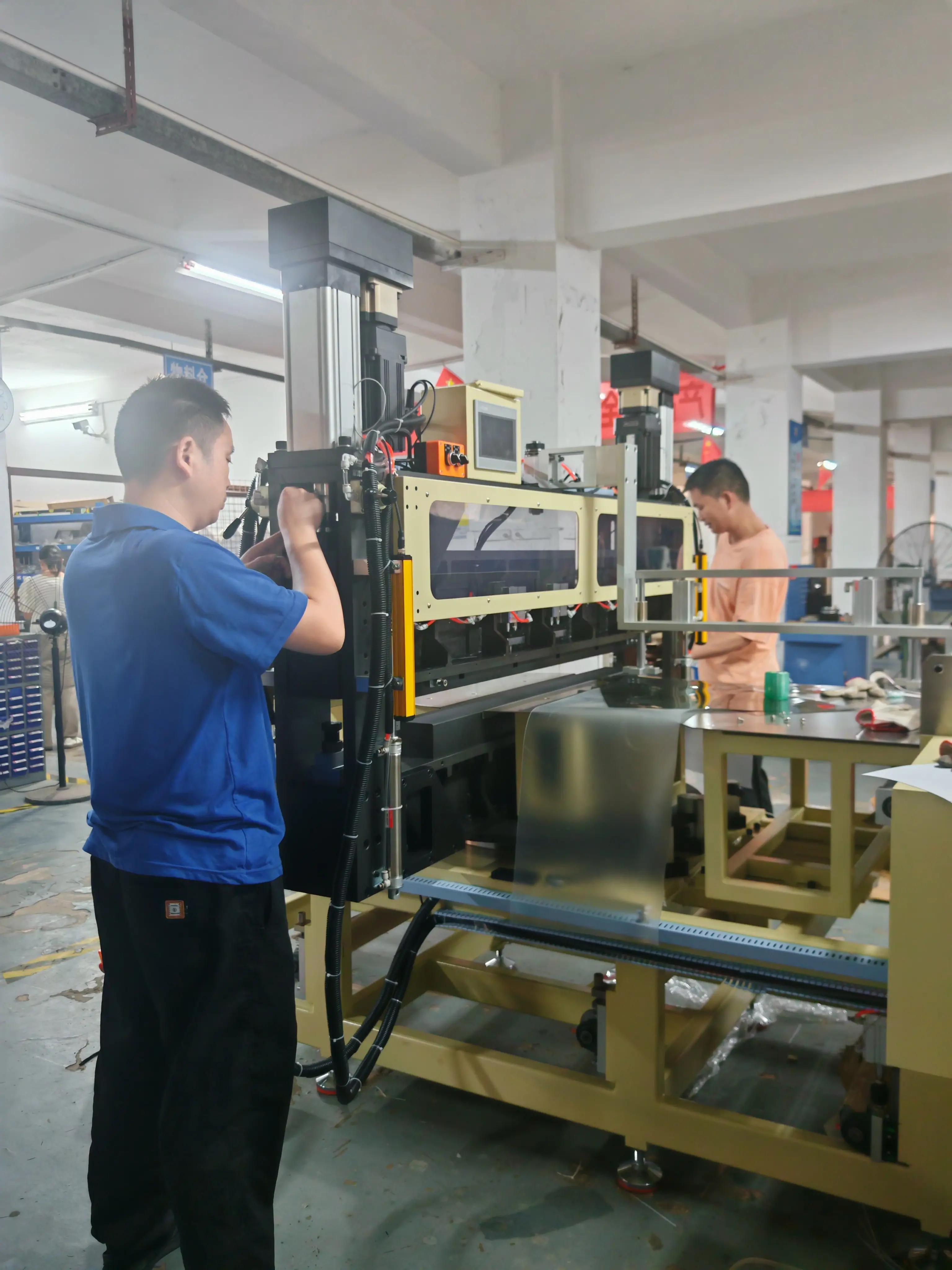
Dual Servo Electric Cylinder Press Cutter
Value Proposition
The value of this machine extends beyond the use of two servo electric cylinders—it transforms a wide-format pressing operation into a coordinated, programmable production process. Material feeding, positioning, clamping, beam movement, and the working stroke are organized as one repeatable cycle. The dual-servo architecture enables driving a wide beam from both sides rather than relying on one central drive point. The servo motion profile allows rapid movement where speed is useful and controlled deceleration where process precision is required. Recipe-based motion simplifies product changeover, and external sensing can be added when process verification is required. Because the machine separates the servo drive function from the guiding structure, it can be engineered for the actual load path rather than expecting the actuator to resolve every mechanical challenge.
For manufacturers processing wide sheet, film, insulation, foam, rubber, laminated, or similar materials, this machine delivers maximum value when the production requirement is not simply "move down and move back up," but rather: feed accurately, hold the material, maintain controlled operation across a wide tool, apply the right stroke at the right speed, repeat the operation consistently, and change the process when the product changes. That is where servo electric cylinders transcend their role as components and become the controlled process axes of the machine.
Why JiuRong Serves as a Core Motion Component Supplier
A servo electric cylinder deployed in a machine of this nature is not an accessory—it is an integral part of the main force and motion path. If the actuator is undersized, poorly matched to the duty cycle, insufficiently stiff, or incorrectly integrated, the consequences extend beyond reduced performance: the machine may lose synchronization, fail to reach required process speed, overheat during continuous production, develop excessive mechanical wear, or lose accuracy under load. Consequently, selecting a supplier for main servo electric cylinders is fundamentally different from purchasing standard pneumatic cylinders. The supplier must possess the engineering capability to support the machine from the application condition backward, and JiuRong's electric-cylinder platform is built around precisely this engineering approach.
Comprehensive Product Range Covering General and Heavy Process Duties
JiuRong's single-stage JRDG platform covers a broad spectrum of servo electric cylinder applications, offering both ball-screw and planetary-roller-screw configurations based on required force, cycle rate, stiffness, and service life. The current JRDG range delivers 0.67–382 kN thrust with stroke options up to 300 mm, and the product family includes both inline direct-drive and parallel side-mounted arrangements. This breadth is significant for machine builders: a wide-format processing machine does not always require the largest available actuator—one application may need moderate force with high positioning speed, while another may demand substantially higher repetitive force and greater mechanical stiffness. The actuator architecture can therefore be selected according to the machine duty rather than forcing disparate machines onto one standard cylinder design.
Ball Screw and Roller Screw Options for Duty Profile Matching
JiuRong does not position any single screw technology as the universal solution. For general positioning and pressing duties, ball screws provide efficient and serviceable solutions. For sustained high-load, high-cycle operation, and applications requiring greater stiffness under force, planetary roller screws deliver higher load density and superior suitability for extreme duty. This distinction is particularly relevant to sheet-processing equipment: a machine operating at moderate force with relatively low cycle count may not require the cost or capacity of a heavy roller-screw actuator, while a press-cutting machine cycling every few seconds over long production shifts likely does. The correct decision derives from the process profile—a more useful engineering approach than selecting actuators solely from headline thrust specifications.
Actuator Matching to Machine Layout
Mechanical packaging often presents practical constraints in machine design. JiuRong's JRDG family supports both inline and parallel drive arrangements. The inline arrangement provides a direct mechanical path with high rigidity and minimal backlash, while the parallel arrangement reduces axial installation length and allows motor mounting beside the cylinder. For a machine with two vertical actuators mounted above a wide beam, this gives the designer options to balance overall machine height, motor access, rigidity, serviceability, transmission ratio, and surrounding tooling and guarding. This flexibility matters because the actuator must fit the machine architecture, not force the machine to be redesigned around the actuator.
Electric Cylinder as Part of a Closed-Loop Motion Axis
The mechanical cylinder is one component within a larger system. JiuRong defines the complete motion path as:
motion controller --> servo drive --> servo motor --> transmission --> screw --> piston rod --> process load
with separate identification of the encoder feedback loop and optional process-measurement loop. This distinction is important in a dual-servo machine. The customer may require only a mechanical actuator, or a matched servo motor and drive package, or a more complete force-position process system—these are different supply scopes. JiuRong explicitly separates the mechanical electric cylinder, the controlled linear axis, and the complete servo process or press function. For machine builders, this helps define responsibility before equipment design and quotation.
Selection Based on Real Operating Conditions, Not Catalogue Ratings
The most important reason JiuRong can support this type of machine is not the maximum thrust number, but the engineering boundaries considered during selection. JiuRong's application guidance addresses several conditions that directly affect a dual-servo sheet-processing machine: side load and external guidance, buckling on long compression strokes, impact peak force, thermal duty, force-speed interaction, complete-system accuracy, vertical-axis holding, and operating environment. These are precisely the areas where actuator problems typically manifest after a machine enters production. For example, JiuRong does not treat maximum force as continuous force; continuous duty is checked against motor heating, cycle rate, motion/rest time, and acceleration. Nor does it assume maximum force and maximum speed can always be achieved simultaneously; motor power, torque-speed capability, drive current, acceleration, and thermal conditions must be evaluated together. This directly impacts a machine that may require fast approach, high-force process stroke, and fast return.
Machine Structure Considered in Accuracy Analysis
A common mistake in actuator selection is treating actuator repeatability as machine accuracy. JiuRong's engineering guidance explicitly rejects this assumption. A precise electric cylinder installed on a flexible plate, beam, or frame cannot produce the same precision at the tool under load—mounting deformation, machine stiffness, thermal expansion, screw grade, and feedback arrangement all contribute to the real result. This is particularly important for the dual-servo machine described here. The real machine requirement is not simply that each cylinder repeats its position accurately, but that the complete moving beam remains within required position and parallelism tolerance under actual process load. This requires actuator, beam, guide, and frame design to be considered together.
Side Load as a Machine Design Issue
Electric cylinders are designed primarily for axial force. JiuRong's application guidance makes clear that off-axis loading should be carried by external machine guidance rather than by internal screw and bearings. This aligns directly with wide dual-servo machine architecture: the electric cylinders generate vertical force, the guide structure controls the moving beam, and the machine frame carries the reaction load. Keeping these functions separate protects screw life, bearings, positioning stability, and long-term repeatability. For a machine builder, this is more important than simply purchasing an actuator with a high nominal load rating.
Heavy-Duty Options for Demanding Processes
For higher-force pressing and forming applications, JiuRong's reinforced JRDG configurations extend into the heavy-duty range. The current heavy-pressing category employs roller-screw options covering 60–382 kN, with reinforced construction aimed at sustained force and high-cycle operation. This provides a path for applications moving beyond light positioning into heavy pressing, repeated forming, high-load assembly, and more demanding press-cutting duty. Again, the point is not that every machine should use the largest cylinder, but that the same engineering platform can be scaled according to process requirements.
Vertical-Axis Requirements Addressed During Selection
The cylinders in this machine operate vertically, introducing a fundamental safety and holding requirement since the moving beam remains subject to gravity when power is lost. JiuRong's application guidance includes motor brakes for vertical holding and calls for redundant braking or mechanical locking where machine risk assessment requires it. This means the vertical installation condition is treated as part of actuator configuration rather than as an afterthought—essential when the electric cylinder forms part of a machine's main moving structure.
Environmental Protection Matched to Industrial Use
Servo electric cylinders are often installed close to tooling, material dust, lubricants, cutting debris, or cleaning processes. JiuRong lists IP65 as standard on the single-stage platform, with higher protection options available on selected configurations. More importantly, the selection process considers the actual operating environment, including contamination, temperature, water exposure, and cleaning requirements—because long-term reliability depends as much on sealing, lubrication, and sensor protection as it does on nominal thrust.
Implications for Machine Builders
JiuRong's role in a machine of this type is therefore not simply to supply two cylinders with sufficient thrust. The more valuable engineering scope is to help match the actuator to:
- required process force
- peak load
- working stroke
- speed profile
- acceleration
- cycle rate
- moving mass
- actuator spacing
- off-center loading
- required synchronization
- machine stiffness
- vertical holding
- environmental conditions
- expected service life
The result is a servo electric cylinder selected for the machine's actual production duty rather than for a single catalogue number. For a dual-servo sheet feeding, pressing, and cutting machine, this distinction is critical. The electric cylinders sit directly in the machine's main motion and force path—their stiffness, life, thermal capability, transmission technology, mounting arrangement, and control compatibility influence the performance of the complete equipment.
That is why JiuRong can serve as a core motion component supplier for this type of machine: not because the company supplies an electric cylinder with a high force rating, but because the actuator platform can be configured around the load, motion, duty, control, and mechanical constraints that determine whether the machine will actually work reliably in production.
 How to Choose a Cost-Effective Actuator for a Riveting Press
Leave a Reply