Why the Booster Cylinder Press Stroke Architecture Matters for Battery Tab Forming
Battery tab forming does not require the actuator to produce maximum forming force throughout every millimetre of travel.
That distinction is important when designing the press axis.
In this application, a JiuRong hydro-pneumatic booster cylinder is mounted vertically over the forming station inside an enclosed battery-production machine. The significant engineering decision is not merely the use of a high-force cylinder. It is the separation of approach motion from loaded forming motion.
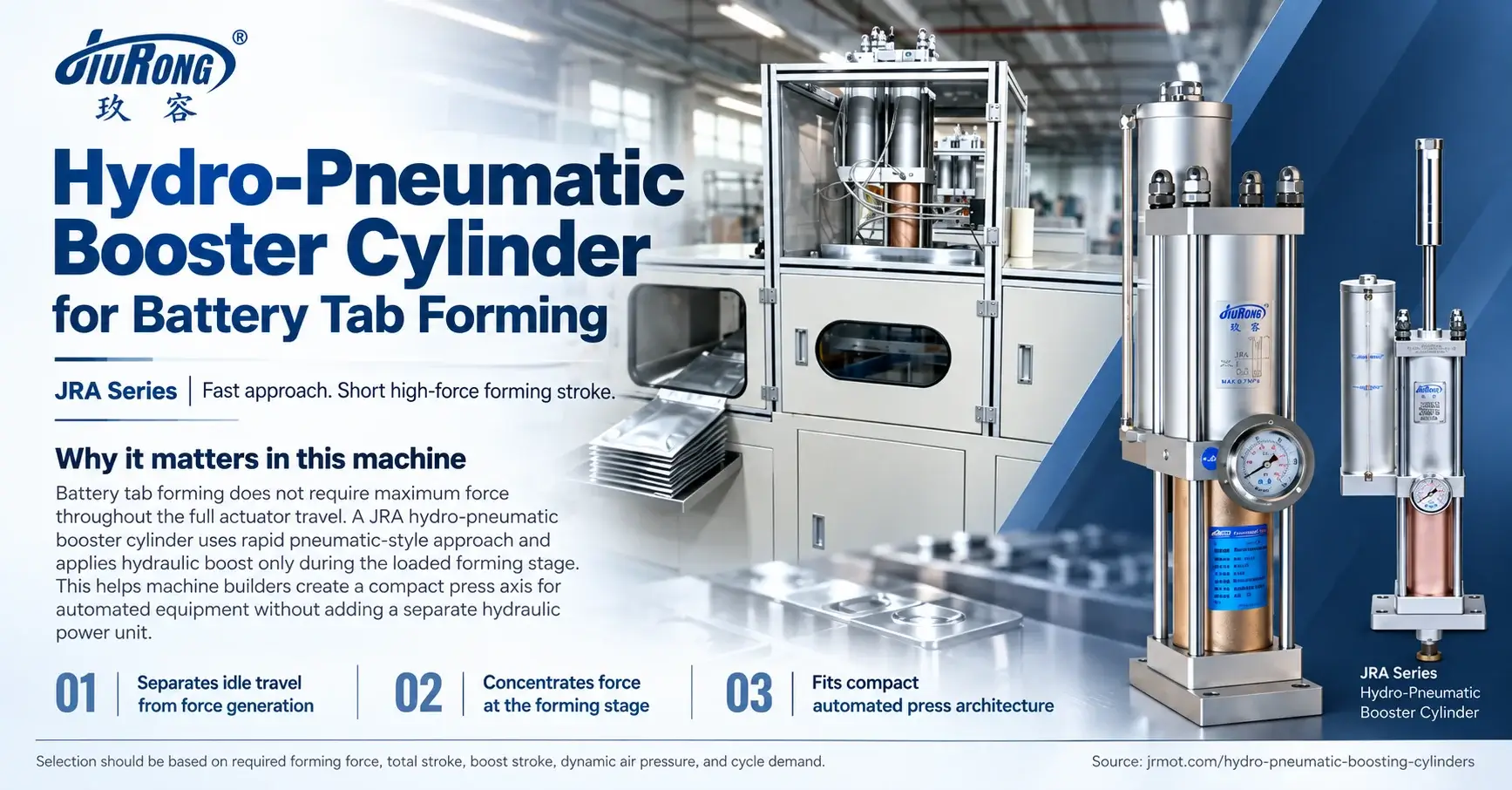
That is where the hydro-pneumatic architecture becomes relevant.
The Forming Load Exists Only in Part of the Machine Stroke
Before a forming tool can apply load to a battery tab, the actuator normally has to travel from its retracted position toward the tooling and workpiece.
Most of that movement does not require the same force as the actual forming event.
A standard JRA pre-press booster cylinder is designed around this distinction. JiuRong describes the operating sequence as a rapid pre-press approach followed by a separate boost-forming stage. During the approach stage, compressed air moves hydraulic oil to advance the working piston rapidly. Once the tool reaches the working position, the booster piston acts on the hydraulic circuit and raises oil pressure for the short loaded stroke.
For a tab-forming station, that gives the machine designer two different operating conditions within one actuator:
Approach Travel
Move the tool toward the tab without unnecessarily generating full forming force.
Forming Travel
Generate the higher force required when the tooling is actually acting on the tab.
This is a more useful way to understand the actuator than treating it simply as a pneumatic cylinder with a larger force rating.
Why That Distinction Matters in an Automated Battery Machine
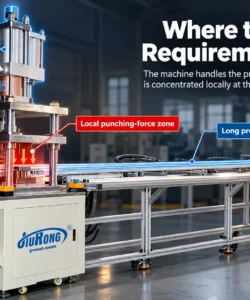
The application machine is an enclosed automation system rather than a standalone hydraulic press. The booster cylinder occupies the vertical working axis above the tooling area, while the remainder of the machine retains the architecture of a conventional automated production cell.
That physical relationship matters.
A conventional pneumatic actuator is attractive for automation because the air system and directional control are relatively straightforward, but increasing pressing force purely by increasing pneumatic piston area can make the actuator progressively larger.
A conventional hydraulic press solves the force problem differently, but normally introduces a hydraulic power unit and associated hydraulic infrastructure.
The hydro-pneumatic booster cylinder sits between those two architectures.
JiuRong describes the principle as converting low-pressure compressed air into higher hydraulic pressure through differential piston areas, allowing hydraulic pressing force to be generated without an external hydraulic pump.
In the battery-tab-forming machine, the practical implication is that hydraulic force generation is concentrated inside the press actuator and used during the loaded part of the cycle, rather than requiring the whole machine to be designed around a separate hydraulic power system.
That is the main engineering meaning of this application.
The Cylinder Is Part of the Press Architecture, Not Simply an Added Component
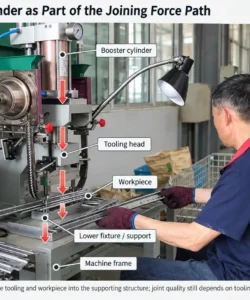
The application image also makes another point clear: actuator selection cannot be separated from machine layout.
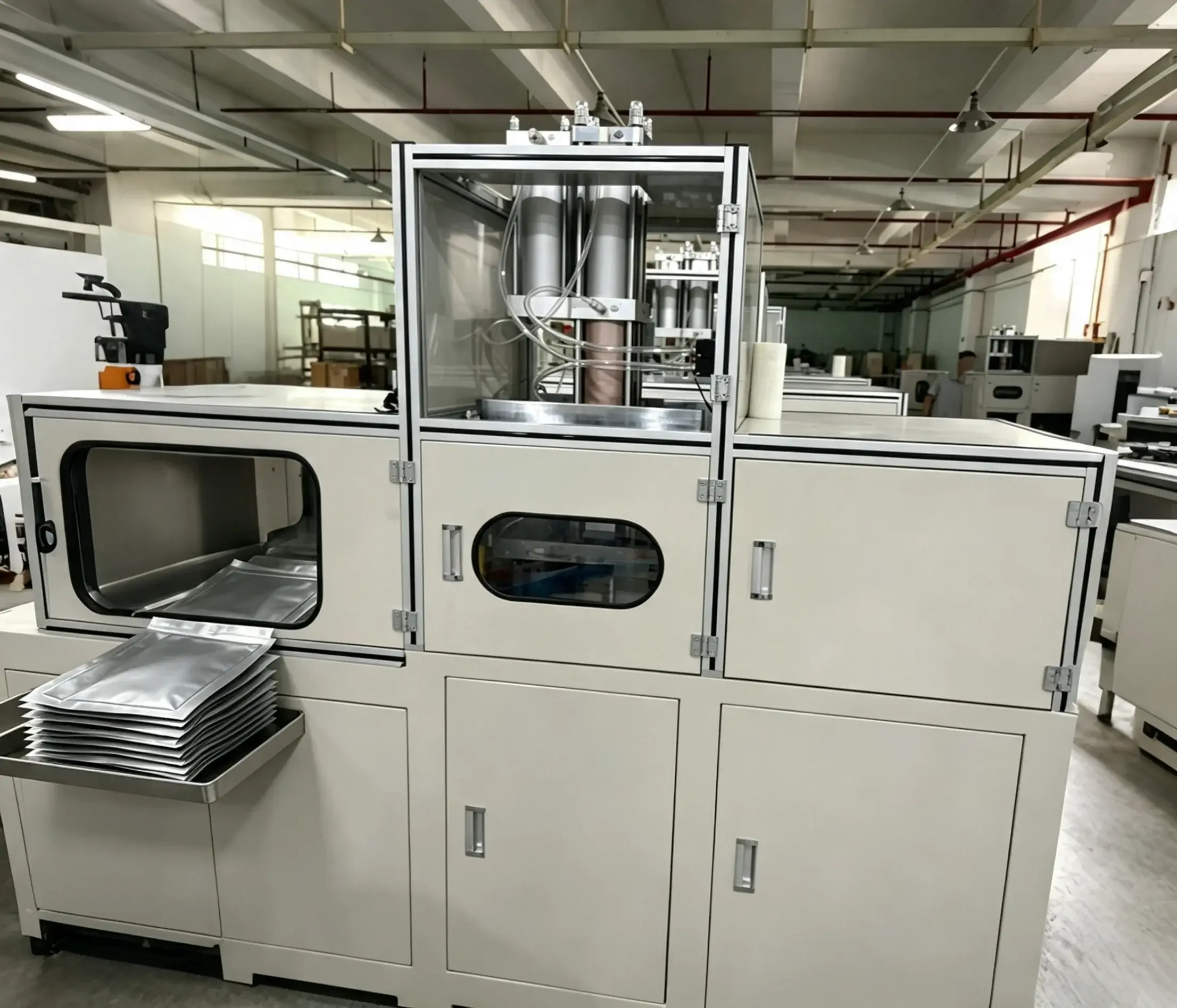
The booster cylinder is mounted vertically and aligned with the working station. That arrangement establishes the primary press-force path from the actuator through the tooling toward the workpiece and machine structure.
For a machine builder, the cylinder therefore affects more than nominal tonnage. It influences:
- available installation height;
- tool approach distance;
- required loaded working stroke;
- shut height and tooling relationship;
- structural load path;
- air-supply demand;
- cycle sequencing.
The product page identifies the JRA family as a standard pre-press design with fast approach followed by a short power stroke and supports vertical installation.
This matches the basic machine relationship visible in the supplied application.
What cannot be determined from the image is whether the installed unit uses the maximum available stroke or force of any particular JRA model. Those are selection variables, not visual facts.
Why a Short Power Stroke Is Important
The boost stage should not be thought of as the complete actuator stroke.
Its purpose is to provide the required load over the portion of travel where load actually exists.
This distinction becomes important during sizing.
JiuRong's engineering-selection guidance separates rapid approach / pre-stroke from loaded power stroke and asks for both values independently, together with required process force, dynamic air pressure and production rate.
That is particularly relevant to a forming machine.
If the tooling requires a long movement before touching the part but only a short loaded forming displacement, designing around the maximum force for the complete travel would solve the wrong problem.
The more useful design question is:
How much travel is unloaded, and how much travel must actually carry forming load?
That answer helps determine whether a standard pre-press booster architecture is appropriate and how the cylinder should be sized.
What Should Be Specified for a Battery-Tab-Forming Axis
The photograph can confirm the integration concept, but it cannot select the cylinder.
For engineering selection, the important inputs are the actual process requirements:
Required Forming Force
Required forming force determines the working-force requirement rather than relying on a catalog maximum.
Total Actuator Travel
Total actuator travel establishes how far the tooling must move between its home position and the working region.
Loaded Power Stroke
Loaded power stroke identifies the portion of travel during which the tab-forming load is present.
Available Dynamic Air Pressure
Available dynamic air pressure matters because booster output ultimately depends on the pneumatic supply available while the machine is operating, not merely the static pressure shown at the compressor.
Production Rate
Production rate affects whether the available air flow, stroke arrangement and actuator configuration can support the intended cycle.
JiuRong explicitly recommends evaluating process load, design force, pressure and bore, oil volume and power stroke, followed by duty and installation checks.
Those inputs are more important than choosing a cylinder from nominal tonnage alone.
Where the JRA Architecture Fits This Application
The JRA standard pre-press family is intended for applications in which a relatively fast approach is followed by a shorter high-force working stroke. JiuRong lists pressing, stamping and forming among the applications for this architecture.
The supplied battery-tab-forming case gives that product architecture a concrete machine context.
Its engineering value is the combination of:
- pneumatic-style approach motion;
- localized hydraulic force generation;
- direct vertical integration into the forming station.
For the machine builder, that can provide a practical route when ordinary pneumatic force is insufficient but the process does not require high hydraulic force throughout a long working stroke.
The boundary is equally important: where high force must continue through a long stroke, or where programmable position, velocity and force profiles are fundamental requirements, a different actuator architecture may be more appropriate. JiuRong itself distinguishes these cases from the normal hydro-pneumatic booster-cylinder operating envelope.
For battery-tab forming, cylinder selection should therefore start with the actual forming force, total stroke, loaded power stroke, dynamic air pressure and required production rate rather than with the cylinder's maximum catalog rating.
 Two Pressing Points, One Setup? What a Dual-Head Riveting Station Must Get Right
 How to Choose a Cost-Effective Actuator for a Riveting Press
 Why a Booster Cylinder Fits the Punching Station of a Long Aluminum Profile Machine
 When Hydro-Pneumatic Booster Cylinders Fit Riveting, Clinching and Press-Fit Equipment
Leave a Reply