Direct-drive VS Pre-press Type Air-oil Intensifiers
JiuRong has two Pressure Types of Hydro-Pneumatic Booster Cylinders, Direct-Pressure and Pre-Pressurized Gas–Liquid Boosters.
The main difference is not simply the pressure level. It is how the booster fits into the machine’s work cycle.
A direct-pressure booster is generally better suited to providing high pressure to another mechanism, such as a clamp, lock, small hydraulic actuator, die, fixture, or localized high-pressure device. A pre-pressurized booster is generally better suited to performing a complete mechanical action, such as pressing, riveting, stamping, forming, assembly, or testing.
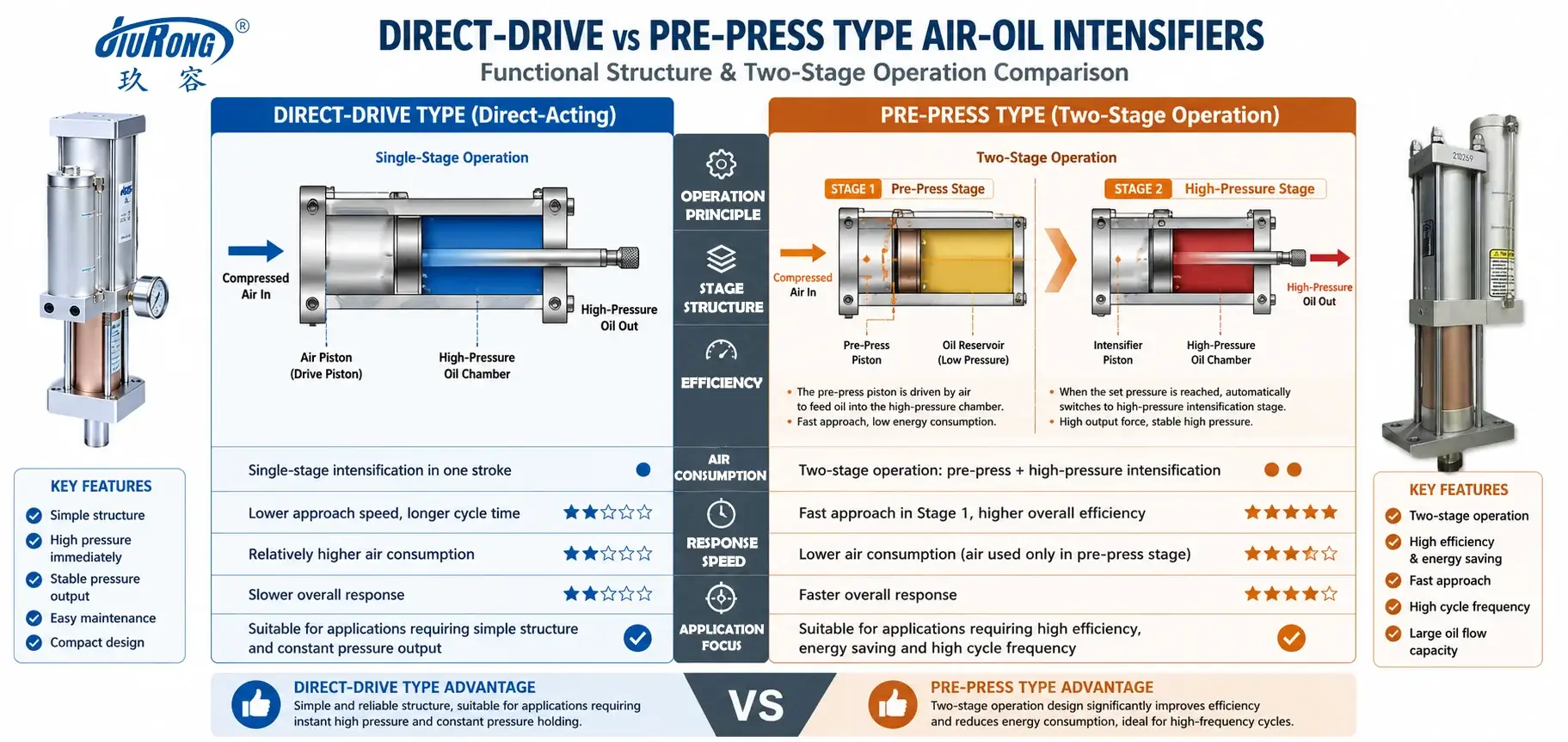
Core Difference
| Consideration | Direct-pressure type | Pre-pressurized type |
|---|---|---|
| Primary role | Supplies high pressure to another mechanism | Directly supports a mechanical working cycle |
| Typical integration | A power module inside a larger machine | A more complete press or actuator function |
| Main requirement | Generate or transfer localized high pressure | Coordinate movement and working force |
| Typical applications | Clamping, locking, small hydraulic actuators, dies, fixtures | Press-fitting, riveting, stamping, pressing, forming, assembly, testing |
| Motion-cycle emphasis | Pressure delivery is the main concern | Approach → Contact → Press → Return |
| Selection focus | Required pressure, interface, and pressure delivery | Complete stroke, working position, force, return, and cycle control |
Direct-Pressure Type: High Pressure as a Machine Function
A direct-pressure gas–liquid booster is more suitable when the machine already has a defined mechanism that performs the physical action.
In this arrangement, the booster primarily provides high pressure for a downstream component. The machine may use that pressure to:
- Hold or clamp a workpiece
- Lock a mechanism
- Drive a small hydraulic actuator
- Apply force through a die or fixture
- Provide localized high pressure within a larger system
The booster therefore functions as a power module. Its value lies in delivering the required pressure to another part of the machine without necessarily becoming the entire working mechanism.
This architecture is often appropriate when the equipment designer already controls the motion, positioning, and return functions elsewhere in the machine.
Pre-Pressurized Type: A Complete Working Action
A pre-pressurized gas–liquid booster is more suitable when the equipment must perform a defined mechanical operation directly.
Many industrial actions require more than pressure generation. They require a sequence: Approach → Contact → Press → Return
For example, a press-fitting or riveting operation must first move toward the workpiece, make contact at a controlled position, apply force during the working phase, and then return for the next cycle.
The same principle applies to:
- Pressing
- Stamping
- Forming
- Assembly
- Testing
Compression operations
In these applications, the booster is selected as part of the working motion rather than only as a source of high pressure. Stroke, working position, force application, return behavior, and cycle coordination become part of the selection decision.
Why the Application Determines the Better Choice
The required output pressure alone does not determine which structure is appropriate.
Two machines may require similar pressure but have different architecture:
- If the machine already contains the moving mechanism and only needs a compact high-pressure source, the direct-pressure type may be suitable.
- If the booster must participate in the full working movement and complete a repeatable mechanical cycle, the pre-pressurized type may be more suitable.
The key question is:
Does the booster only need to provide high pressure, or must it also support the machine’s complete working action?
Selection Checklist
Before choosing a structure, confirm the following:
- Is the booster supplying pressure to another actuator, clamp, lock, die, or fixture?
- Or must it directly perform pressing, riveting, stamping, forming, assembly, or testing?
- Who controls the approach and return movements?
- Is the working position defined independently from the pressure-generation function?
- What force and stroke are required during the actual working phase?
- Must the booster operate as part of a repeated Approach → Contact → Press → Return cycle?
- Are the available product specifications sufficient for the required pressure, stroke, force, and installation conditions?
Practical Recommendation
Choose a direct-pressure structure when high pressure is needed as one internal power function of a larger machine.
Choose a pre-pressurized structure when the booster must contribute directly to a complete mechanical operation, especially one involving approach, contact, pressing, and return.
Because terminology and internal construction can vary between manufacturers, the final decision should be confirmed against the supplier’s product drawings, pressure and stroke data, installation requirements, and cycle-control documentation.
 Two Pressing Points, One Setup? What a Dual-Head Riveting Station Must Get Right
  How to Choose a Cost-Effective Actuator for a Riveting Press
  Why a Booster Cylinder Fits the Punching Station of a Long Aluminum Profile Machine
  When Hydro-Pneumatic Booster Cylinders Fit Riveting, Clinching and Press-Fit Equipment
Leave a Reply