Where the JiuRong Hydro-Pneumatic Booster Cylinder Fits in High-Force Linear Actuation
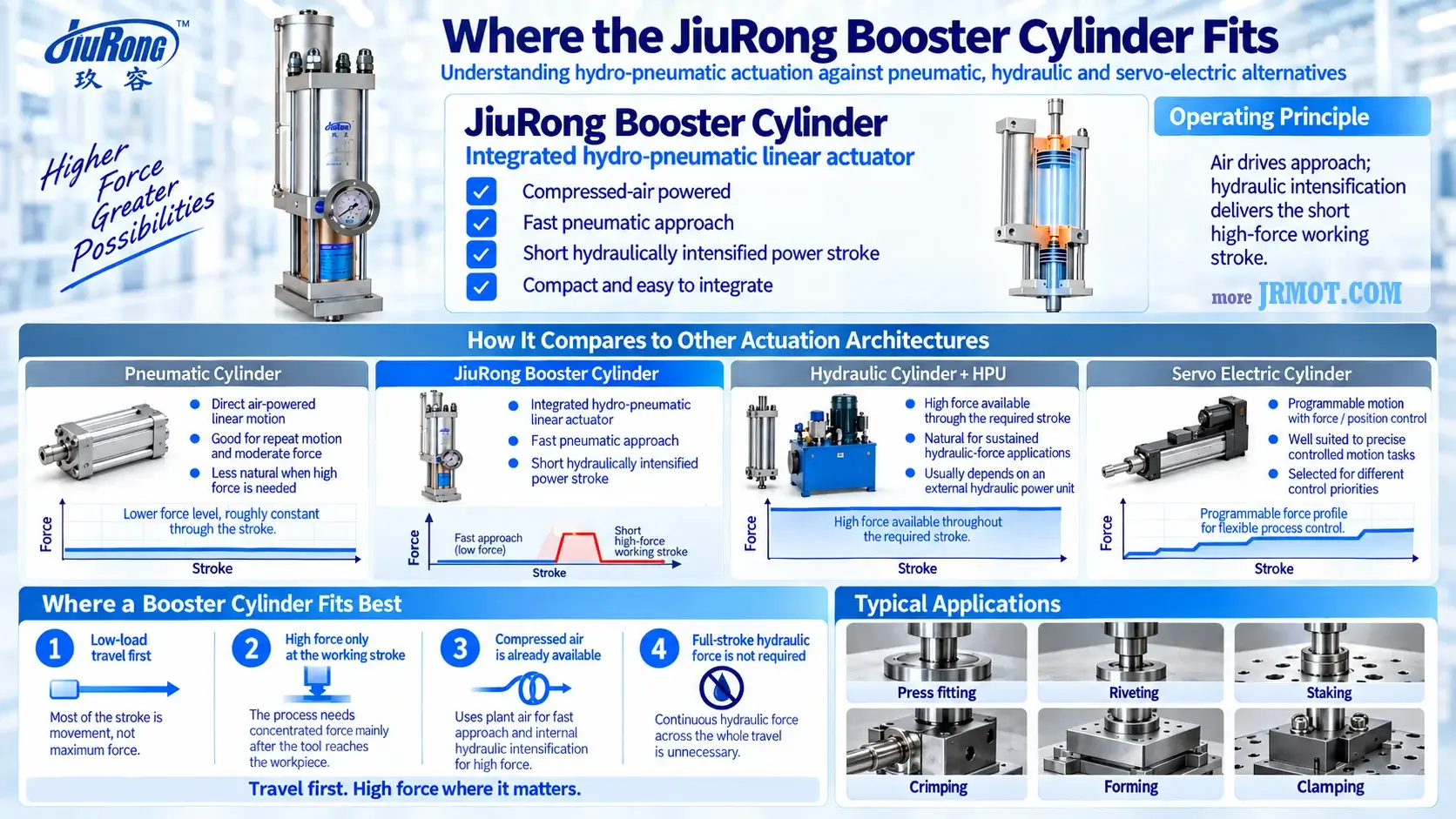
Choosing a linear actuator becomes easier once the force requirement is separated from the total travel requirement.
A pneumatic cylinder, hydraulic cylinder, hydro-pneumatic booster cylinder and servo-electric cylinder may all produce linear motion, but they solve different force–stroke requirements.
For the JiuRong Hydro-Pneumatic Booster Cylinder, the defining question is not simply:
How much force can the actuator produce?
A more useful question is:
Where along the stroke is that force actually required?
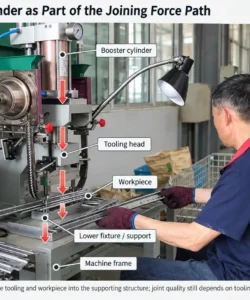
Many pressing and assembly processes involve a relatively long approach movement followed by a much shorter working stroke where substantially higher force is required.
That motion pattern can be simplified as:
Rapid approach → contact → short high-force working stroke
The JiuRong Booster Cylinder is designed around that type of load profile. Compressed air provides the approach motion, while hydraulic intensification provides the higher force required during the working portion of the stroke.
This gives the actuator a distinct engineering position among pneumatic, hydraulic and servo-electric alternatives.
The Force–Stroke Profile Is the Real Selection Variable
A standard pneumatic cylinder converts compressed-air pressure directly into linear force.
It is a natural solution where the machine requires:
- simple linear movement;
- rapid repetitive motion;
- moderate force;
- straightforward control.
As working-force requirements rise, increasing pneumatic cylinder bore size eventually becomes less attractive because the actuator becomes larger and air consumption increases.
A hydro-pneumatic booster cylinder changes the actuation architecture rather than simply continuing to increase pneumatic cylinder size.
Compressed air remains the primary utility, but hydraulic intensification is used during the short high-force stage.
The engineering distinction is therefore:
Direct pneumatic actuation → pneumohydraulic intensified actuation
A conventional hydraulic cylinder solves the force problem differently.
It receives pressurized oil from a hydraulic system, typically including a hydraulic power unit, reservoir, pump, valves and associated piping. That architecture can provide high force through a substantial part of the required working stroke and is therefore a natural choice where sustained high force is important.
A servo-electric cylinder addresses another set of priorities.
Its engineering value lies primarily in programmable motion, positioning, repeatable motion profiles and force-position control rather than pneumatic-hydraulic intensification.
The comparison can therefore be reduced to four different design priorities:
| Architecture | Natural design priority |
|---|---|
| Pneumatic cylinder | Simple, rapid repetitive motion with moderate force |
| JiuRong Hydro-Pneumatic Booster Cylinder | Rapid low-load approach followed by a short high-force working stroke |
| Hydraulic cylinder + HPU | Sustained high force over a substantial working stroke |
| Servo-electric cylinder | Programmable position, force and motion behavior |
The useful comparison is not which actuator is universally stronger or better.
It is:
How much force is required at each point in the stroke?
A machine that requires 150 mm of total movement but only a few millimetres of high-force pressing has a fundamentally different actuator requirement from a machine that needs high force across most of the same travel.
That distinction is what makes the force–stroke profile a more useful selection variable than maximum force alone.
Related Terms That Are Often Confused
Several terms used around hydro-pneumatic systems describe related technologies, but they are not interchangeable.
Air-over-oil / pneumohydraulic
Air-over-oil is a broader operating principle in which compressed air acts through an oil circuit.
Not every air-over-oil system uses pressure intensification. Some use air and oil primarily to obtain hydraulic motion characteristics or smoother speed control.
The JiuRong Booster Cylinder belongs to the more specific category of integrated pneumohydraulic intensified actuation.
Pressure intensifier
A pressure intensifier may simply generate high-pressure hydraulic oil for another device.
For example:
Compressed air → intensifier → high-pressure oil → separate actuator
That is different from an integrated booster actuator, where approach motion, intensification and working-force generation are incorporated more directly into one actuator architecture:
Compressed air → pneumatic approach → hydraulic intensification → working force
The two technologies are related, but they should not be treated as the same product.
Short-stroke high-force actuator
“Short-stroke high-force actuator” describes an application requirement rather than one specific actuator technology.
Hydro-pneumatic booster cylinders, hydraulic cylinders, intensifier-driven hydraulic actuators, servo-electric actuators and mechanical systems can all potentially address short-distance high-force work.
The term therefore describes the job:
High force is required over a limited working distance.
The actual actuator still has to be selected from the complete machine requirement.
The JiuRong product discussed here can therefore be described more precisely as:
An integrated pneumohydraulic linear actuator that uses compressed air for rapid approach and hydraulic intensification for a short high-force working stroke.
Where the JiuRong Booster Cylinder Fits Naturally
The Booster Cylinder becomes particularly relevant when several conditions occur together:
- most of the actuator travel is relatively low-load movement;
- high force is needed mainly during a short working stroke;
- compressed air is already available;
- sustained hydraulic force through the entire stroke is unnecessary;
- the process involves pressing, forming, joining or clamping.
Typical examples include:
- press fitting;
- riveting;
- staking;
- crimping;
- punching;
- forming;
- clamping.
These applications may come from very different industries, but they can share the same mechanical pattern:
travel first, force later.
The industry name is therefore less important than the load profile.
Where Another Architecture May Be More Natural
The JiuRong Booster Cylinder should not be treated as a universal substitute for pneumatic, hydraulic or servo-electric actuation.
A conventional hydraulic cylinder may be the more natural architecture when:
- high force is required through a long portion of the stroke;
- sustained hydraulic loading is part of the process;
- the machine already relies on hydraulic power for multiple functions.
A servo-electric cylinder may be more appropriate when:
- programmable position and force behavior are central to the process;
- motion profiles need frequent adjustment;
- process feedback and electronic control flexibility dominate the requirement.
A standard pneumatic cylinder may remain fully sufficient when:
- required force remains moderate;
- motion is simple;
- process-control requirements are limited.
The engineering boundary is therefore not about declaring one actuator architecture superior.
It is about matching the architecture to the way force is required across the machine cycle.
For the JiuRong Hydro-Pneumatic Booster Cylinder, the characteristic pattern is:
fast low-load travel → contact → short high-force working stroke.
That is the most useful basis for deciding whether this actuator architecture belongs in a machine.
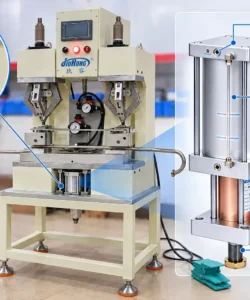 Two Pressing Points, One Setup? What a Dual-Head Riveting Station Must Get Right
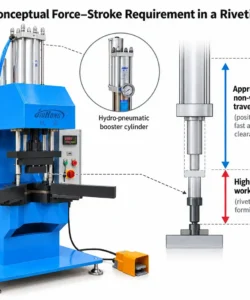 How to Choose a Cost-Effective Actuator for a Riveting Press
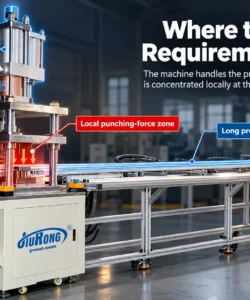 Why a Booster Cylinder Fits the Punching Station of a Long Aluminum Profile Machine
 When Hydro-Pneumatic Booster Cylinders Fit Riveting, Clinching and Press-Fit Equipment
Leave a Reply