Why JiuRong Hydro-Pneumatic Booster Cylinder Fits Dry Leak Test Machine
A dry leak test is usually discussed in terms of pressure decay, differential pressure, mass flow, sensors, test pressure and leak rate.
But before any of those measurements become meaningful, the machine has a more basic mechanical task to complete:
the workpiece and test fixture have to form a stable seal.
That makes the actuator used to close the fixture more important than it may first appear.
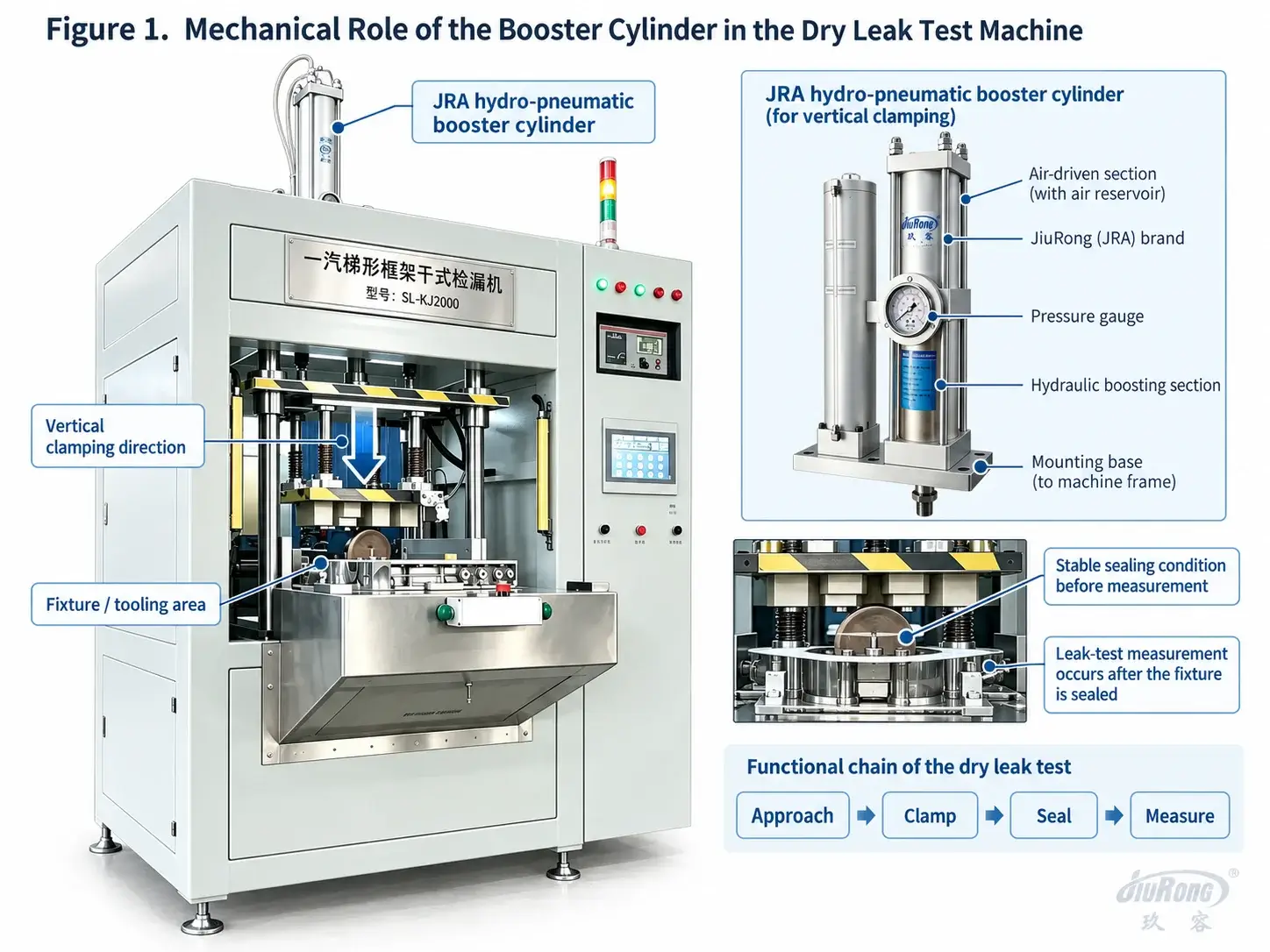
In the dry leak test machine shown in this application, a JRA standard hydro-pneumatic booster cylinder is mounted vertically above the test fixture. Its role is not to detect leakage. It provides the mechanical actuation required to close and hold the fixture before and during the test.
That duty profile is one reason a hydro-pneumatic booster cylinder can be a natural fit for this type of station.
Leak Measurement Starts After the Fixture Is Sealed
Consider what the leak tester is actually trying to measure.
In a pressure-decay test, the part is pressurized, isolated from the pressure source and then monitored for pressure change over a defined period.
The measurement therefore assumes that the test boundary has already been established.
That boundary includes more than the workpiece itself. It can also include:
- fixture seals;
- plugged or sealed ports;
- test connections;
- interfaces between the tooling and the part.
If one of those interfaces is not seated correctly, the test system may see leakage that does not originate from the intended workpiece leak path.
This is why leak-test machine builders pay considerable attention to fixturing and sealing.
The actuator therefore has a specific job:
establish the mechanical condition that allows the measurement system to do its job.
The Actuator Does Not Need Maximum Force Through the Entire Stroke
This is where the motion profile becomes important.
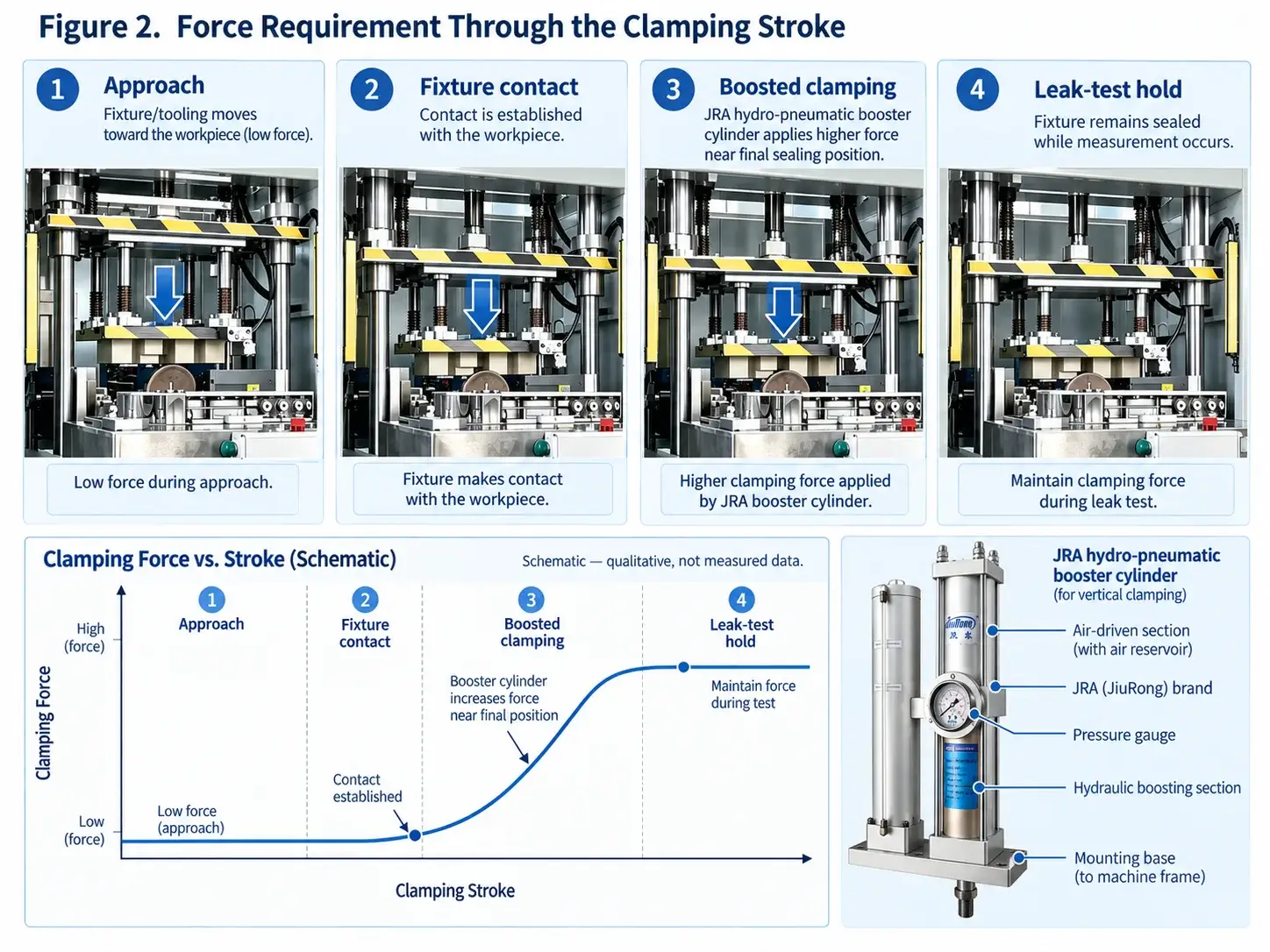
A typical sealing fixture does not necessarily need its highest force while travelling toward the workpiece.
Most of that movement is simply positioning.
The higher force becomes important after the tooling reaches the part and the sealing interface has to be compressed and held.
Conceptually, the sequence looks like this:
Rapid approach → Fixture contact → Final clamping → Leak test → Release
That distinction matters when selecting an actuator.
If a machine only needs substantial force during the final part of the motion, designing the whole actuator around continuous high-force travel may add size or system complexity that the process itself does not require.
A hydro-pneumatic booster cylinder addresses the duty differently. Pneumatic motion can be used for the approach portion, while the boosting stage is used when higher final output force is required at the sealing position.
The important point is not simply that the cylinder can produce “more force.”
It is that its operating principle matches a process in which speed and travel are needed first, while high clamping force is concentrated near the end of the working motion.
Why Final Clamping Force Matters in a Leak-Test Fixture
When a test cavity is pressurized, pressure acts over an effective area and creates a separating force.
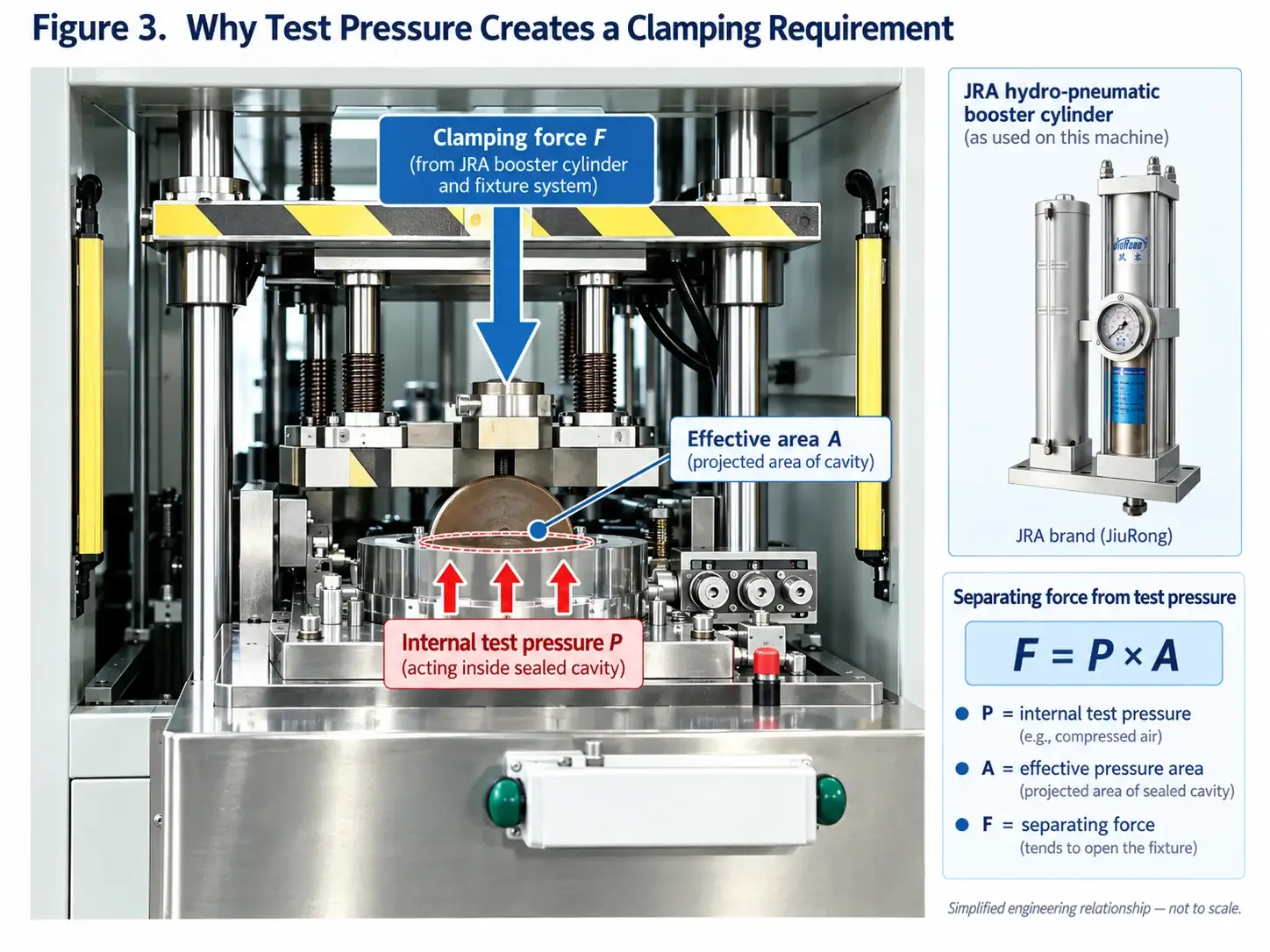
At a simplified level:
F = P × A
where:
- F is the separating force,
- P is internal test pressure,
- A is the effective pressure area.
The fixture must resist that force while also providing enough compression to establish the intended seal.
The actual clamp requirement therefore depends on the workpiece geometry, sealing area, test pressure, seal design, tooling structure and required engineering margin.
This is why a force value from one machine should not automatically be generalized to another.
For the machine in this case, the required clamp capacity is application-specific. The more transferable engineering lesson is the relationship between:
test pressure + sealing geometry + required fixture force.
So “more force” is not the engineering objective.
Enough controlled clamping force to maintain the required sealing condition is.
Why a Booster Cylinder Can Fit This Duty Pattern
For a machine builder, the useful question is not whether a booster cylinder is powerful.
It is whether its actuation characteristics match the station.
In this type of dry leak test fixture, three characteristics can align particularly well.
Rapid Motion Before Sealing
The fixture must first travel to the workpiece.
That portion of the stroke does not normally require the same force as final sealing.
Using pneumatic motion for this travel allows the actuator to approach the workpiece without treating the entire stroke as a high-force pressing operation.
Higher Force at Final Contact
Once the fixture reaches the sealing position, the mechanical requirement changes.
The machine now needs enough force to compress the sealing interface and resist the forces acting on the fixture during the test.
This is where the boost stage becomes relevant.
The actuator architecture concentrates higher output force at the part of the cycle where the fixture actually needs it.
Compact Integration Into an Automated Machine
The application image also shows another practical consideration: packaging.
The cylinder is installed vertically above the tooling inside a relatively compact enclosed machine.
For machines already designed around pneumatic automation, a hydro-pneumatic actuator can provide a way to combine pneumatic actuation with locally generated hydraulic boosting at the actuator rather than automatically requiring a conventional centralized hydraulic power architecture.
That does not make it universally simpler than every alternative.
It does mean the architecture is worth considering where the machine needs:
- rapid approach motion;
- substantially higher force at final fixture closure;
- intermittent rather than full-stroke high-force demand;
- compact vertical integration;
- compatibility with an existing pneumatic machine architecture.
Where Another Actuator Architecture May Make More Sense
A booster cylinder should not be selected simply because the station requires force.
The complete duty profile still matters.
A conventional pneumatic cylinder can remain a natural solution when the required clamp force can be produced with an acceptable cylinder size.
A hydraulic system may be more natural when the machine requires sustained high force, extensive hydraulic functionality, multiple hydraulic axes or a hydraulic infrastructure that already exists.
A servo-electric actuator may become relevant when programmable position, force or motion control is a primary machine requirement.
The useful selection question is therefore not:
Which actuator is best?
It is:
Where in the machine cycle is force required, how much is required, for how much travel, and what machine architecture has to support it?
For a dry leak test fixture that mainly needs fast positioning followed by a short high-force sealing phase, those conditions can align well with hydro-pneumatic boosting.
The Important Boundary Between Clamping and Measurement
The clearest way to understand this application is to separate two functions.
The leak tester handles the measurement.
The booster cylinder handles the mechanical preparation required before that measurement can begin.
That gives the machine a simple functional chain:
Approach → Clamp → Seal → Measure
Seen this way, the booster cylinder is not present merely because the machine needs a large force value.
It is there because the fixture needs a specific force-versus-motion profile.
For machine builders and automation engineers, that distinction is more useful than the nominal tonnage of one installation.
It turns an isolated application case into a practical actuator-selection question:
Does the process require low-load travel first and substantially higher clamping force only at the final sealing position?
When the answer is yes, a hydro-pneumatic booster cylinder is an architecture worth evaluating and fit the Clamping and Sealing Stage of a Dry Leak Test Machine.
 Two Pressing Points, One Setup? What a Dual-Head Riveting Station Must Get Right
 How to Choose a Cost-Effective Actuator for a Riveting Press
 Why a Booster Cylinder Fits the Punching Station of a Long Aluminum Profile Machine
 When Hydro-Pneumatic Booster Cylinders Fit Riveting, Clinching and Press-Fit Equipment
Leave a Reply